Search Results for: lter

History of Data Nuggets

Because Data Nuggets originated from a partnership of teachers and scientists, they address both the needs of scientists to share their research broadly while developing their communication skills, and of teachers who need resources that address education reform and teach science in an authentic way.


Data Nuggets are designed and developed by Elizabeth Schultheis and Melissa Kjelvik from Michigan State University. They have been under development since 2011 and originated through conversations between science teachers and graduate students during the NSF GK-12 project “New GK-12: Using the STEM Dimensions of Bioenergy Sustainability to Bring Leading-edge Graduate Research to K-12 Learning Settings”. This unique opportunity for collaboration between teachers and scientists led to the creation of teacher-inspired resources. Teachers shared that they were lacking educational resources that helped their students practice working with real, messy data like that collected during classroom inquiry-based projects. Graduate students in the sciences, not surprisingly, have lots of practice working with messy data and surprising results. Through this collaboration, Data Nuggets were created to bring real data from current and ongoing research into the classroom and take students through the process of science, from the inception of ideas to the analysis and interpretation of data.

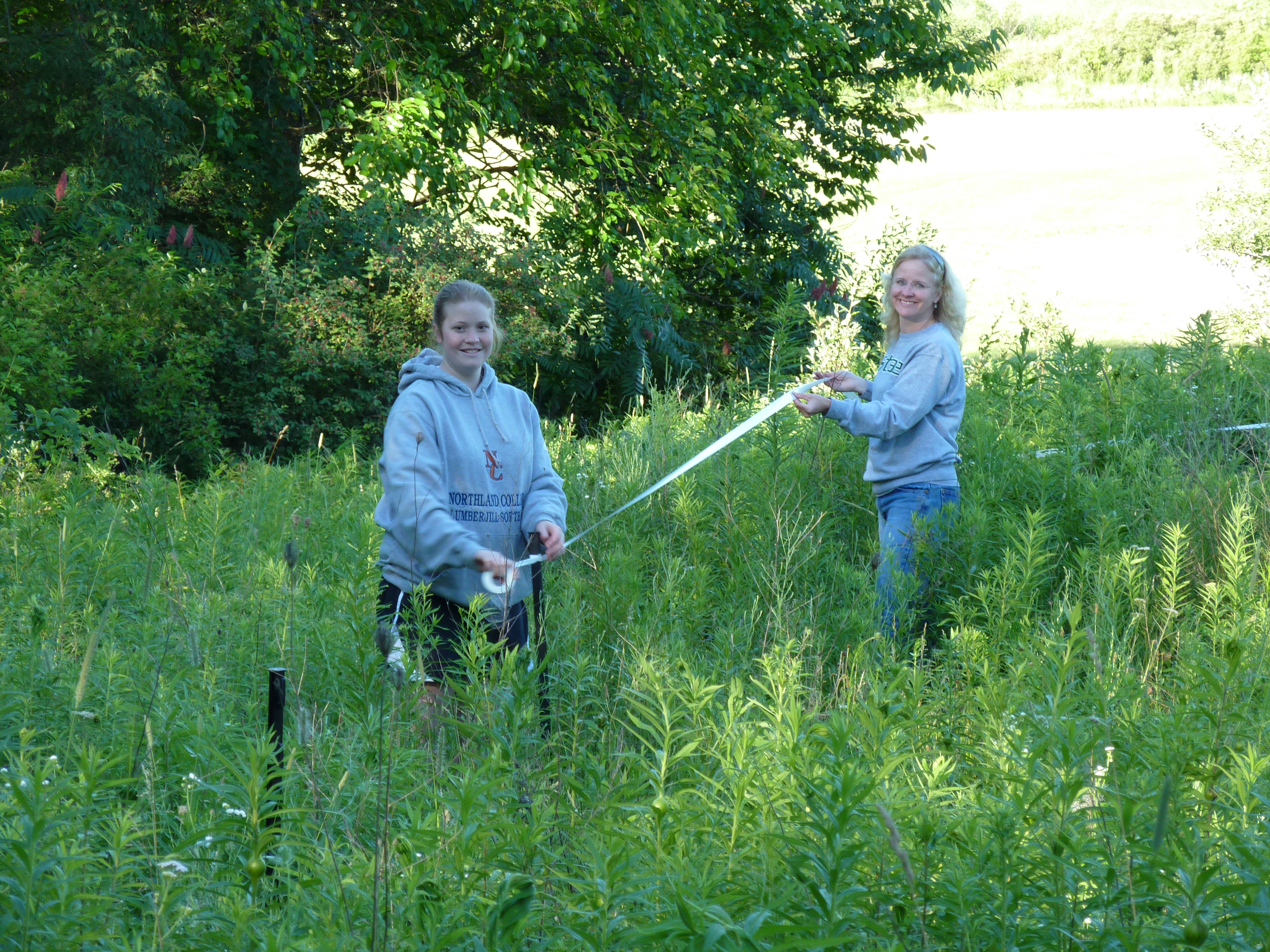
Melissa Kjelvik and teacher Connie High working together to collect scientific data.

Melissa Kjelvik and teacher Connie High working together to collect scientific data.

From 2013-2015, Data Nuggets were funded with seed grants from the NSF BEACON Center Study of Evolution in Action. These funds allowed us to greatly expand Data Nuggets as a resource, with activities now being developed in response to workshops held across the BEACON consortium. The funding has also provided opportunities to collaborate with science educators at Understanding Science (UCMP), National Institute for Mathematical and Biological Synthesis (NIMBioS), and Biological Sciences Curriculum Study (BSCS) to further refine the template and to align Data Nuggets with current science standards and reform, making them easier to integrate into existing curriculum.

Data Nuggets are currently funded by a 4-year NSF DRK-12 grant, awarded to MSU and BSCS in 2015, to conduct a research study to evaluate the effectiveness of integrating Data Nuggets into science curriculum. This research will help to determine whether these short activities can increase the mathematical skills of students and their ability to think scientifically and support claims using data.

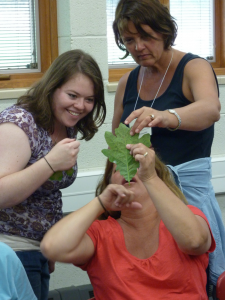
Liz Schultheis working with teachers to collect herbivory data.

Liz Schultheis working with teachers to collect herbivory data.

We will continue to develop and revise Data Nuggets to help teachers bring sets of data from graduate student research into their classroom, and help students become comfortable working with messy data and unexpected results. Data Nuggets have gone through an iterative development process, where materials developed by scientists were used in the classroom and modified based on teacher and student experiences and feedback. We continue to present Data Nuggets at national and local education conferences where teachers and science educators can provide feedback on the structure and content of each activity. Our innovative and iterative development approach has led to a product that teachers and students find easy to work with and integrate into existing curriculum.

For more information on Data Nuggets, see our paper in the American Biology Teacher: Click here for a PDF!

BY MATH & SCIENCE CONCEPTS

Below, you will find a table of all the current Data Nuggets available. Click on the Title to open a page displaying the Data Nugget, teacher guide, student activities, grading rubric, and associated resources. The table can be sorted using the arrows located next to each column header. It can also be searched by keyword using the search bar, located to the top right of the table.

If you are looking for additional data to use with your students, search “full dataset available” to find Data Nuggets where the scientists have provided the full datasets behind the research in the activity. Email datanuggetsK16@gmail.com to get a copy of these data!

To help introduce these science and math concepts to your students, check out this set of resources.

TitleContent LevelScience Concepts / KeywordsQuantitative Concepts / StatisticsGraph Type(s)Variable Type(s)Data Type(s)
Dangerously bold1animals, animal behavior, tradeoff, fish, predation, biological significancepercent, standard error (SE), predictionsbarcategoricalsummarized, Digital Data Nugget
Coral bleaching and climate change1climate change, coral reef, marine, mutualism, temperature, animals, algae, adaptation, evolutionratiobarcategoricalsummarized, Digital Data Nugget
Won’t you be my urchin?1coral reef, herbivory, marine, sea urchin, water, animals, competition, food webmean, models, standard error (SE), standard deviation (SD)barcategoricalraw
Springing forward1 & 3climate change, phenology, plants, temperaturemean, standard error (SE), Julian datebarcategoricalsummarized, full dataset available, Digital Data Nugget
Do urchins flip out in hot water?1 & 3animals, climate change, marine, heatwaves, urchins, behavior, invertebrates, environmental changeaverage, mean, standard error (SE), calculationbarcategorical, continuoussummarized, two levels available,
Do insects prefer local or foreign foods?2herbivory, invasive species, plants, insects, enemy release, ecologymean, variance, standard deviation (SD), standard error (SE), confidence intervals (CI), predictionsbarcategoricalsummarized, full dataset available, Digital Data Nugget
Spiders under the influence2animals, invertebrates, habitat, chemical pollution, aquatic, streams, scientist profilemean, multiple variablesmultiple barcategoricalfull dataset, students summarize
Do invasive species escape their enemies?2herbivory, invasive species, plants, insects, enemy release, ecologymean, percentbarcategoricalsummarized
Lake Superior Rhythms2amplitude, aquatic, atmosphere, environmental, physics, student research, wave period, wavescycle, sine wave, amplitude, change over timesine wavecontinuoussummarized, full dataset available
All washed up? The effect of floods on cutthroat trout2animals, disturbance, ecology, fish, water, stream, floods, alternative hypotheses, limnologyregression, ratio, rate, graph choice, unnecessary variables, long-term datascattercontinuousraw, Digital Data Nugget
Float down the Kalamazoo River2Kalamazoo River, water, suspended solids, dam, reservoir, limnologymean, ratio, rate, standard deviation (SD), standard error (SE), Julian date, unnecessary variablesbar, linecategorical, continuoussummarized, Digital Data Nugget
Finding a foothold2animals, ecology, marine, substrate, waterfrequency, proportionbarcategoricalsummarized
Is chocolate for the birds?2experimental design, agriculture, animals, birds, biodiversity, rainforest, succession, disturbance, transect, habitataddition, unnecessary variablesbarcategoricalraw, full dataset available, Digital Data Nugget
Fish fights2animal behavior, animals, fish, matingmean, proportion, regressionscattercontinuoussummarized, Digital Data Nugget
Marvelous mud2ecology, environmental, fertilization, mud, phosphorus, substrate, water, wetland, limnologypercent, regression, graph choicescattercontinuoussummarized
Which guy should she choose?2animal behavior, animals, fish, matingfrequency, regression, correlation vs. causationscattercontinuousraw, summarized
Sexy smells2adaptation, animal behavior, animals, birds, matingpercent, regression, correlation vs. causationscattercontinuousraw, Digital Data Nugget
Shooting the poop2adaptation, animal behavior, animals, insects, predation, alternative hypothesesmean, standard error (SE)barcategoricalraw
Invasive reeds in the salt marsh2disturbance, invasive species, plants, wetland, limnology, transectmean, percentbarcategoricalraw, summarized
A tail of two scorpions2animal behavior, animals, predationaddition, proportion, ratio, graph choicebar, stacked bar, pie chartcategoricalraw, Digital Data Nugget
Green crabs: invaders in the Great Marsh2animals, invasive species, substrate, wetland, erosion, limnologyaddition, range, mapmapcategorical, spatialraw, summarized
Guppies on the move2animals, aquatics, behavior, ecology, genetics, migration, movement, tropicsregressionline, scattercategorical, continuousraw, full dataset available
The birds of Hubbard Brook, Part I2animals, biodiversity, birds, climate change, succession, disturbance, ecologycount, long-term dataline, scattercontinuousraw, full dataset available, Digital Data Nugget
Beetle battles2adaptation, animals, behavior, competition, evolution, insects, matingstandard error (SE)barcategoricalsummarized
How do brain chemicals influence who wins a fight?2animals, behavior, competition, insects, aggression, brain chemistry, physiologymeanbarcategoricalraw, summarized
Deadly windows2animals, animal behavior, birds, environmental, urban, alternative hypothesesaddition, proportionbarcategoricalsummarized
Which would a woodlouse prefer?2experimental design, animals, behavior, ecology, predationcount, Chi-square test, replication, sample sizebarcategoricalraw, Digital Data Nugget
Tree-killing beetles2animals, biodiversity, disturbance, ecology, environmental, insects, plantsmean, percent, proportion, regressionscattercontinuoussummarized
Alien life on Mars – caught in crystals?2astrobiology, salt, solution, Mars, extraterrestrial life, chemistry, physical sciencemean, time series linecontinuoussummarized, visual, full dataset available
Beetle, it’s cold outside!2animals, climate change, ectotherm, insects, temperaturemean, standard error (SE), modelslinecontinuoussummarized, Digital Data Nugget
Can a salt marsh recover after restoration?2disturbance, salinity, transect, invasive species, plants, wetland, restoration, limnologymean, percent, frequencybar, linecontinuoussummarized
Fast weeds in farmer’s fields2evolution, adaptation, agriculture, plants, fitness, heredity, geneticsfrequency, percent, mean, replication, sample size, unnecessary variablesbar, scattercontinuous, categoricalsummarized
The carbon stored in mangrove soils2carbon, climate change, disturbance, ecology, environmental, nutrients, greenhouse gasses, plants, transectproportion, mean, unnecessary variablesbarcontinuous, categoricalsummarized
Where to find the hungry, hungry herbivores2herbivory, plants, insects, ecology, latitude, longituderegression, standard deviation (SD), standard error (SE)scattercontinuoussummarized
A window into a tree’s world2climate change, dendrochronology, ecology, plants, temperaturemean, relative growth, graph choice, regression, correlation vs. causation, trend line, line, scattercontinuous, categoricalsummarized
Corals in a strange place2adaptation, coral reef, mangrove, morphology, structure and functionvisual data, countbar, stacked bar, pie chartcontinuoussummarized, full dataset available
Mangroves on the move2climate change, disturbance, ecology, environmental, fertilization, nitrogen, nutrients, phosphorus, plantsmean, standard error (SE)barcategorical, continuoussummarized
Getting to the roots of serpentine soil2soil, plasticity, limiting factors, plants, ecology, scientist profilemean, range, standard deviationbarcontinuous, categoricalsummarized
Little butterflies on the prairie2butterflies, prairie strips, prairie, agriculture, crops, farmers, animals, ecology, scientist teamPollard Walk, transect, abundance, count, mean, long-term data, T-testbarcontinuoussummarized, full dataset available
Blinking out?2agriculture, insects, population, ecology, biodiversity, fireflies, scientist profilemoving window, long-term data, standardize, sampling effort, division, count, unnecessary variablesline, scattercontinuous, categoricalsummarized, full dataset available, Digital Data Nugget
PFAS: Our forever problem2PFAS, water, teacher, pollution, watershed, Human impactconcentration, sampling, dilution, bar plotbarcontinuous, categoricalraw, full dataset available
Buried seeds, buried treasure2germination, plants, seed bank, seed viability, scientist profilelong-term data, trendscattercontinuousraw
Mowing for monarchs, Part I2community science, citizen science, animals, behavior, biodiversity, community science, disturbance, ecology, plants, insects, alternative hypothesesaverage, time, rate, fractionbarcategoricalsummarized, full dataset available
A difficult drought2agriculture, biofuels, climate change, plants, carbon, fermentation, ethanol, chemistrymean, range, variability, replication, sample sizebarcontinuous, categoricalsummarized, full dataset available
Farms in the fight against climate change2Carbon, Soil, LTER, climate changeaverage, standard deviation, percent, bar plotbarcategorical, continuoussummarized, raw
Mowing for monarchs, Part II2community science, citizen science, animals, behavior, biodiversity, community science, disturbance, ecology, plants, insects, predation, alternative hypothesesaverage, time, rate, fractionbarcategoricalsummarized, full dataset available
Does more rain make healthy bison babies?2animals, ecology, keystone species, plants, prairie, precipitationmean, time, regression, long-term data, unnecessary variablesline, scattercontinuoussummarized, full dataset available
Benthic buddies2adaptation, animals, arctic, biodiversity, ecology, environmental, invertebrates, lagoons, marinemeanbarcategoricalsummarized
Did you hear that? Inside the world of fruit fly mating songs2animals, insect, process of science, reproducibility, communication, volume, social, behaviorcalculations, index, standard deviation, average, replicatebarcategorical, continuoussummarized
A burning question2biodiversity, canopy, ecology, fire ecology, forest, human impact, keystone species, land management, natural resourcesaverage, timebarcategorical, continuoussummarized
What grows when the forest goes?2fire, forest, invasive species, long-term, plantsaverage, percent, proportion, error barsbarcategorical, continuoussummarized
Anole’s new niche2adaptation, animals, evolution, niche, population, introduced species, native species, behavior, habitat, competitionmean, grand mean, standard deviation (SD), count, unnecessary variablesbarcategorical, continuoussummarized
Salmonberries in our future2Arctic, wetlands, climate change, ecology, disturbance, water, marinemean, standard deviation (SD)multiple barcategorical, continuoussummarized
Can kelp help the plovers? 2marine, beach, herbivory, kelp, preference, behavior, invertebrate, student research, food webaverage, multiple trials, calculationsmultiple barcategorical, continuoussummarized
The science of stamen loss2adaptation, animals, evolution, plants, pollination, traits, natural selection, flowerspercent change, rate, unnecessary variablesbarcategorical, continuoussummarized
Growing kelp for community2environmental, growth, human impacts, kelp, mariculture, marine, photosynthesis, traditional knowledgeaverage, timemultiple linecategorical, continuoussummarized
Testing the waters for oyster farming2applied research, environmental, mariculture, marine, oceanography, oyster, salinity, chemistrymean, average, parts per thousandmultiple barcategorical, quantitativesummarized, full dataset available
What wakes the squirrels?2animal behavior, animals, arctic, behavior, climate change, ecology, environmental, mammals, permafrost, phenologyaverage, correlation vs. causation, Julian date, long-term data, mark-recapture, missing data, trendlinescatterquantitativesummarized, full dataset available
Are plants more toxic in the tropics?3herbivory, diversity, plants, insects, ecology, adaptation, chemistrystandard deviation (SD), standard error (SE), index, formulabarcategoricalsummarized
Does a partner in crime make it easier to invade?3legume, plants, mutualism, rhizobia, invasive species, soil, scientist profilemeanbarcategoricalsummarized
Fair traders or freeloaders?3evolution, legume, plants, mutualism, rhizobia, nitrogen, fertilizationmean, standard error (SE)barcategoricalsummarized
Fertilizing biofuels may cause release of greenhouse gasses3agriculture, biofuels, climate change, fertilization, greenhouse gases, nitrogen, plantsregressionscattercontinuoussummarized, full dataset available, Digital Data Nugget
The ground has gas!3climate change, temperature, greenhouse gases, nitrogen, plants, chemistryregressionscattercontinuousraw, summarized, full dataset available
Growing energy: comparing biofuel crop biomass3agriculture, biofuels, climate change, fertilization, plants, carbonmean, standard error (SE)barcategoricalsummarized
Microbes facing tough times3drought, enzymes, microbes, mutualist, agriculture, climate change, cropsmean, standard deviation, negative valuesbarcontinuoussummarized
How the cricket lost its song, Part I3adaptation, animal behavior, animals, rapid evolution, mating, parasitism, scientist profilepercentbarcategoricalraw, summarized, Digital Data Nugget
The mystery of Plum Island Marsh3fertilization, fish, food web, marine, mollusk, water, wetland, limnologymeanbarcategoricalraw
Invasion meltdown3climate change, ecology, invasive species, plants, temperaturemean, range, replication, sample sizebarcategoricalsummarized, full dataset available
Is your salt marsh in the zone?3climate change, ecology, plants, sea level rise, substrate, wetland, limnologymeanbarcategoricalraw
Lizards, iguanas, and snakes! Oh my!3animals, biodiversity, disturbance, restoration, urban, transectcount, additionbarcategoricalraw
What do trees know about rain?3climate change, dendrochronology, ecology, plants, precipitation, temperature, watermean, formula, equation, addition, multiplicationlinecontinuousraw, full dataset available
CSI: Crime Solving Insects3animals, insects, parasitismweighted meanbarcategoricalraw, Digital Data Nugget
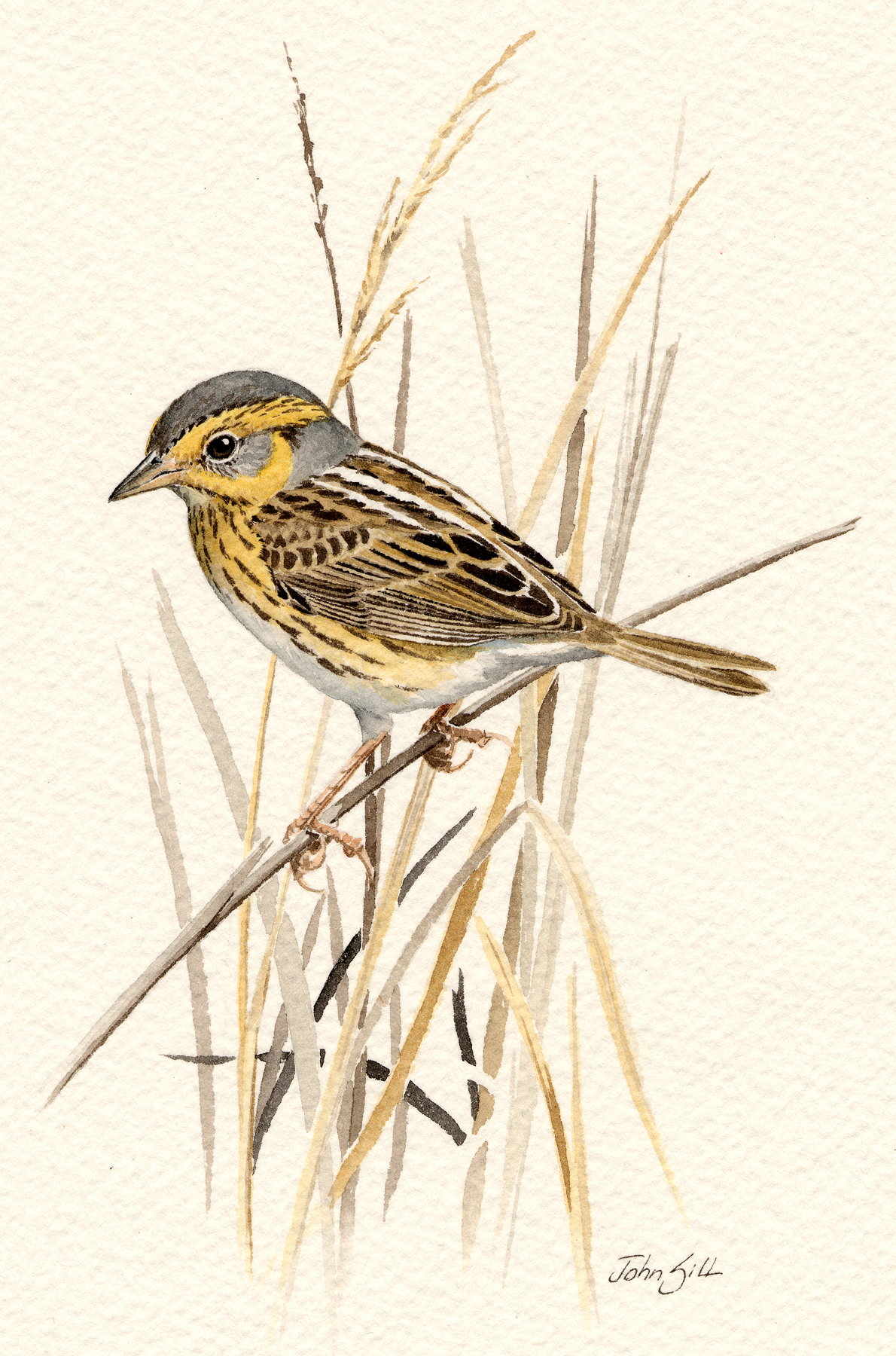
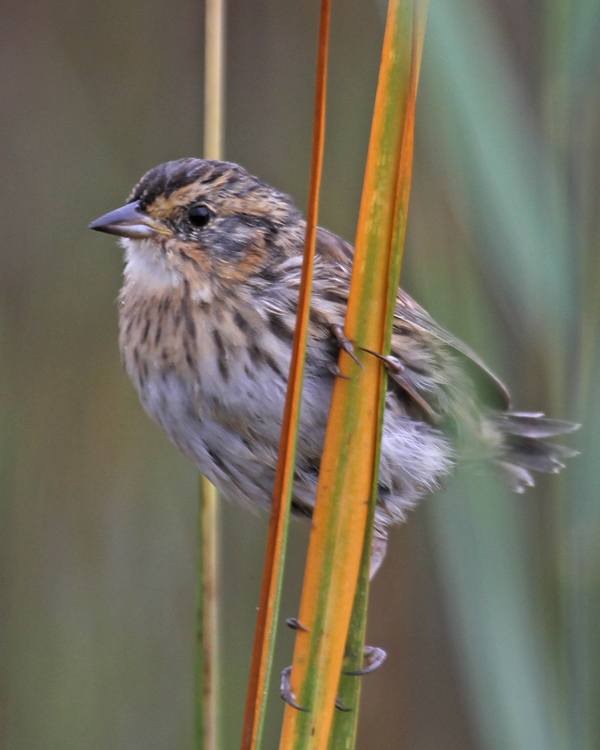
Does sea level rise harm saltmarsh sparrows?3animals, birds, sea level rise, climate change, disturbance, ecology, wetland, limnologymean, standard deviation (SD)linecontinuoussummarized
Keeping up with the sea level3climate change, disturbance, ecology, sea level rise, plants, substrate, wetland, limnologyformula, equation, rateline, scattercontinuous, categoricalraw
The birds of Hubbard Brook, Part II3animals, biodiversity, birds, climate change, succession, disturbance, habitat, ecologycount, long-term dataline, scattercontinuous, categoricalraw, full dataset available, Digital Data Nugget
How the cricket lost its song, Part II3adaptation, animal behavior, animals, rapid evolution, mating, parasitism, scientist profilemeanbarcategoricalraw, summarized. Digital Data Nugget
Feral chickens fly the coop3adaptation, animals, behavior, birds, ecology, evolution, invasive species, mating, heredity, geneticsproportion, percentbarcategoricalraw, summarized
Raising Nemo: Parental care in the clown anemonefish3animals, behavior, coral reef, ecology, fish, marine, mating, tradeoff, plasticity, scientist profilemean, standard error (SE)barcategoricalraw
When a species can’t stand the heat3animals, climate change, disturbance, ecology, environmental, mating, temperature, sex ratioaddition, percent, ratio, regressionscattercontinuousraw, full dataset available, Digital Data Nugget
Are you my species?3adaptation, animals, behavior, biodiversity, competition, evolution, fish, matingformula, equation, addition, subtraction, division, regressionscattercontinuousraw, Digital Data Nugget
Marsh makeover3bodiversity, disturbance, ecology, greenhouse gases, mud, plants, restoration, wetland, limnologystandard error (SE)bar, linecategoricalraw, summarized
To bee or not to bee aggressive3animals, behavior, genes, insects, tradeoff, plasticity, aggressionmean, effect size, percent change, rangebarcategoricalsummarized, full dataset available, Digital Data Nugget
Why are butterfly wings colorful?3adaptation, animals, insects, models, predation, alternative hypothesesfraction, proportion, probabilitybarcategoricalsummarized, Digital Data Nugget
City parks: wildlife islands in a sea of cement3animals, biodiversity, ecology, urban, island biogeography, parks, camera trapShannon Wiener Index, formula, equation, sum, proportion, regressionscattercontinuoussummarized, full dataset available, Digital Data Nugget
Is it better to be bigger?3adaptation, animals, evolution, predation, natural selectionmean, percent, rate, regressionscattercontinuoussummarized, Digital Data Nugget
Is it dangerous to be a showoff?3adaptation, animals, evolution, predation, tradeoff, natural selectionpercent, rate, regressionscattercontinuous, categoricalsummarized
What big teeth you have! Sexual selection in rhesus macaques3animals, evolution, sexual selection, sexual dimorphism, anatomy, form and function, primate, scientist profilemean, standard deviation (SD)barcontinuous, categoricalraw, Digital Data Nugget
Bringing back the Trumpeter Swan3animals, biodiversity, birds, ecology, environmental, restorationmean, long-term data, countlinecontinuous, categoricalraw, full dataset available, Digital Data Nugget
Are forests helping in the fight against climate change?3climate change, carbon, ecology, greenhouse gasses, photosynthesis, plants, decomposition, respirationregression, long-term datascattercontinuousraw, Digital Data Nugget
Can biochar improve crop yields?3agriculture, environmental, fertilization, plants, soil, water, biochar, carbonpercent, mean, standard deviation (SD), yield, replication, sample size, randomizationbarcontinuous, categoricalsummarized
Hold on for your life! Part I3adaptation, animals, disturbance, evolution, natural selection, genetic drift, hurricane, biological significance, alternative hypothesesargumentation, mean, standard error (SE)barcontinuous, categoricalsummarized
Hold on for your life! Part II3adaptation, animals, disturbance, evolution, natural selection, genetic drift, hurricaneargumentation, visual datavisualraw, photo, video
Testing the tolerance of invasive plants3ecology, herbivory, invasive species, plants, tolerancestatistical interaction, mean, standard error (SE)barcategoricalsummarized, full dataset available
Picky eaters: Dissecting poo to examine moose diets3animal behavior, animals, ecology, foraging, herbivory, parks, predator-prey1:1 line, proportion, mean, unnecessary variablesscattercontinuous, categoricalsummarized, full dataset available
Candid camera: capturing the secret lives of carnivores3animals, biodiversity, carnivores, ecology, island biogeography, richness, camera trap, parksregressionmap, scattercontinuoussummarized, Digital Data Nugget
Crunchy or squishy? How El Niño events change zooplankton3algae, animals, marine, El Niñooutlier, correlation vs. causation, unnecessary variablesline, scattercontinuousraw, Digital Data Nugget
Streams as sensors: Arctic watersheds as indicators of change3climate change, ecology, environmental, carbon, nitrogen, permafrost, limnologyunnecessary variables, regression, long-term datascattercontinuoussummarized
The end of winter as we’ve known it?3climate change, ice cover, student researchJulian date, mean, regression, messiness, variabilityscattercontinuoussummarized, full dataset available, Digital Data Nugget
Working to reduce the plastics problem3plastics, synthetic materials, chemistry, biodegradable, elastomer, polymer, monomer, stress, strain, physical sciencepercent, ratiolinecontinuoussummarized
Limit by limit: Nutrients control algal growth in Arctic streams3nitrogen, nutrients, phosphorus, nutrient limitation, law of the minimum, Arctic, limnologyresponse ratio, graph choice, standard deviation (SD)barcategoricalsummarized
To reflect, or not to reflect, that is the question3albedo, arctic, climate change, environmental, ice, temperature, waterequation, unnecessary variables, regressionline, scattercontinuoussummarized
How milkweed plants defend against monarch butterflies3herbivory, evolution, coevolution, plants, insects, ecology, scientist profilemean, regression, best fit line, trend line, multiple dependent variables, messiness, outlierline, scattercontinuoussummarized
Purring crickets: The evolution of a new cricket song3adaptation, animal behavior, animals, rapid evolution, mating, parasitism, scientist profilemean, percent, Chi-square testbarcategoricalraw, Digital Data Nugget
Round goby, skinny goby3local adaptation, animals, biodiversity, rapid evolution, fish, Great Lakes, habitat, invasive species, Kalamazoo Rivermean, standard error, replication, sample sizebarcategoricalsummarized, full dataset available
David vs. Goliath3aggression, animals, behavior, brain chemistry, competition, insects, physiology, biological significancefrequency, proportion, percent, unnecessary variablesbarcategoricalraw, summarized
Size matters - and so does how you carry it!3adaptation, animals, evolution, insects, sexual selection, tradeoffsresiduals, trend, multiple graphs, standardizescatter, linecontinuousraw, summarized, full dataset available
Do you feel the urban heat?3urban, climate change, extreme heat, environmental justice, human impacts, socioeconomic, sensorsmaximum, minimum, averages, time, baselinemultiple linecontinuous, categoricalsummarized
Ant wars!3aggression, animals, behavior, competition, insectsdensity, ratio, percent, regression, countbar, line, scattercontinuousraw, summarized
Salty sediments? What bacteria have to say about chloride pollution3bacteria, chemistry, disturbance, environmental, microbes, pollution, salt, urban, water, habitat, time, toxicitymean, concentrationbarcategoricalsummarized
Going underground to investigate carbon locked in soils 3climate change, ecology, environmental, greenhouse gasses, soil carbon, microbes, chemistrymean, standard deviation (SD), regression, best fit line, trend line, correlation vs. causationline, scattercontinuoussummarized
Nitrate: Good for plants, bad for drinking water3agriculture, environmental, fertilization, nitrogen, soil, water, plants, human health mean, time, date, Julian date, concentrationline, scattercontinuous, categoricalsummarized, full dataset available
Trees and the city3biodiversity, ecology, environmental justice, social demographics, urbanspatial data analysis, percent, binned data, average, median, histogrammultiple scatter, spatial mapcontinuousspatial, summarized, full dataset available
Collaborative cropping: Can plants help each other grow?3agriculture, environmental, plants, cropsreplicates, correlation vs. causation, regression, trendmultiple scattercontinuousraw
The sound of seagrass3acoustics, sound, photosynthesis, marine, productivity, decibels, physicsaverage, mean, standard deviation, trend, timemultiple scatter, linecontinuoussummarized
Which tundra plants will win the climate change race?3climate change, nutrients, long-term data, competition, plants, ecologymean, trend, time, series, control, long-term datalinecontinuoussummarized
The prairie burns with desire3ecology, prairie, plants, fire ecology, human impact, reproduction, land managementtrend, time, multiple plots, multiple variables, long-term data, proportion, averagescatter, linecontinuoussummarized, full dataset available
Seagrass survival in a super salty lagoon3climate change, ecology, environmental, long-term, marine, plants, salinitydouble y-axis, trend, time, multiple variablesscattercontinuoussummarized
Sink or source? How grazing geese impact the carbon cycle3carbon cycle, Arctic, wetlands, primary production, photosynthesis, respiration, climate change, birds, ecosystemequation, calculation, subtraction, negative values, source, sinkbarcategorical, continuoussummarized
Poop, poop, goose!3wetlands, Arctic, carbon cycle, climate change, disturbance, ecology, environmental, greenhouse gasses, birdsmean, standard deviation (SD), fluxbarcategoricalsummarized
Too hot to help? Friendship in a changing climate3mutualism, algae, coral, genotype, photosynthesis, respiration, climate changecalculations, negative values, net, mean, average, standard errorbarcategorical, continuoussummarized
Does the heat turn caterpillars into cannibals?3animal behavior, insect, virus, disease ecology, temperature, cannibalism, caterpillarcalculation, percents
barcategorical, continuoussummarized
climate change, disturbance, ecology, environmental, growth, human impact, plants, water, wetlands3climate change, disturbance, ecology, environmental, growth, human impact, plants, water, wetlandsmean, average, mass, barquantitative, qualitative
summarized
A plant breeder’s quest to improve perennial grain4genetics, artificial selection, DNA, selective breeding, phenotype, genotype, nucleotides, sequencingcalculations, average, predictions, standard error, standard deviation, barcontinuous, categoricalsupplemental activity available,
Cheaters in nature – when is a mutualism not a mutualism?4evolution, legume, plants, mutualism, parasitism, rhizobia, nitrogen, fertilizationmean, standard error (SE)barcategoricalsummarized
Dangerous aquatic prey: can predators adapt to toxic algae?4adaptation, algae, evolution, marine, predationmeanbarcategoricalsummarized
Salmon in hot water4adaptation, animals, climate change, evolution, fish, genes, genome, temperature, DNA, heredity, genetics, QTLmeanlinecontinuoussummarized
Urbanization and estuary eutrophication4algae, eutrophication, fertilization, marine, nitrogen, phosphorus, wetland, urban, photosynthesis, respiration, limnologymean, standard error (SE), subtraction, modelbarcategoricalraw
How to escape a predator4adaptation, animal behavior, animals, predation, physiology, evolutionmean, standard error (SE), unnecessary variablesbarcategoricalraw, summarized
The flight of the stalk-eyed fly4physics, moment of intertia, adaptation, animals, flight, physiologymean, standard error (SE), formula, equation, multiplicationcontinuoussummarized
Make way for mummichogs4animals, biodiversity, disturbance, fish, restoration, wetland, limnology, student researchmeanbar, linecontinuousraw, summarized
The Arctic is melting – so what?4climate change, marine, temperature, water, weather, ice, Arctic, albedopercent, modelsdiagramcategorical, modeled datasummarized
Gene expression in stem cells4gene expression, genes, stem cells, DNA, genetics, human healthmeanbarcategoricalsummarized, Digital Data Nugget
Bon Appétit! Why do male crickets feed females during courtship?4adaptation, animals, behavior, competition, insects, mating, feeding, alternative hypotheses, scientist profilecount, proportion, regression, multiple regression, unnecessary variablesscattercontinuousraw, Digital Data Nugget
Winter is coming! Can you handle the freeze?4ecology, evolution, genes, plants, local adaptation, QTLpercent, standard deviation (SD), standard error (SE)bar, linecategoricalraw, summarized
Finding Mr. Right4animals, animal behavior, biodiversity, birds, evolution, genes, mating, local adaptationmeanbarcategoricalraw
Why so blue? The determinants of color pattern in killifish, Part I4adaptation, animals, biodiversity, evolution, fish, genes, mating, heredity, genetics, close reading activitymean, standard deviation (SD), standarad error (SE)barcategoricalraw, summarized
Why so blue? The determinants of color pattern in killifish, Part II4adaptation, animals, biodiversity, evolution, fish, genes, mating, heredity, geneticsmean, standard deviation (SD), standarad error (SE)barcategoricalraw, summarized
Sticky situations: big and small animals with sticky feet4adaptation, animals, biomimicry, chemistry, physics, scalemean, ratio, multiplication, formula, equation, surface area, mass, volumescatter - logarithmic axescontinuoussummarized
When whale I sea you again?4climate change, marine, temperature, water, whales, DNA, PCR, sex ratiofraction, percent, ratioline, stacked barcontinuous, categoricalraw, Digital Data Nugget
The case of the collapsing soil4climate change, carbon, ecology, plants, phosphorus, sea level rise, respiration, substrate, wetland, limnologyregression, concentrationscattercontinuousraw, Digital Data Nugget
Clique wars: social conflict in daffodil cichlids4animal behavior, animals, competition, fishcount, standard deviation (SD), standarad error (SE)barcategoricalsummarized, Digital Data Nugget
Fishy origins4community science, citizen science, DNA, evolution, fish, PCR, marine, microsatellitespercent, proportion, addition, divisionbar, stacked barcontinuous, categoricalraw
Fertilizer and fire change microbes in prairie soil4biodiversity, diversity, grassland, microbes, plants, prairie, soilunnecessary variables, Shannon Wiener Index, meanbarcontinuous, categoricalsummarized
Breathing in, Part I4photosynthesis, carbon accumulation, carbon sequestration, climate change, forest, habitatmean, confidence, global databasebarcontinuous, categoricalsummarized, full dataset available
Breathing in, Part 24climate change, photosynthesis, respiration, carbon, climate modelprecision, percent, model prediction, mean, calculation, equationbarcontinuous, categoricalsummarized, full dataset available
Stop that oxidation! What fruit flies teach us about human health4insects, model species, cell biology, genetics, cellular processes, oxidation, genetics, scientist profilemeanbarcontinuous, categoricalraw, summarized
Love that dirty water4environmental, urban, water, GIS, landscapes, impervious surfaces, ecosystem services, land acknowledgement, human healthmodel, web-tool, simulation, percent change, calculation, mapbar, line, mapcategorical, continuoussummarized
Trees and bushes, home sweet home for warblers4animals, biodiversity, disturbance, ecology, birds, succession, transect, habitatregression, best fit line, trend line, percentscattercontinuoussummarized
Changing climates in the Rocky Mountains4citizen science, climate change, community science, ecology, environmental, plants, precipitation, temperaturemean, trend, timeline, double y-axiscontinuous, categoricalsummarized, photo
Surviving the flood4disturbance, urban, stream, floods, photosynthesis, respiration, stormwaterreference line, percent, negative values, additional variables, difference, unnecessary variables, outlierscatter, linecontinuousraw, summarized
Eavesdropping on the ocean4acoustic ecology, physics, whales technology, mammals, marine biology, renewable energy, population, human impactproportions, calculation, detectionsscatter, barcategorical, continuoussummarized, full dataset available
Reconstructing the behaviour of ancient animals4anatomy, animals, behavior, form and function, fossils, nocturnal, paleobiology, primatemean, average, range, maximum, minimum, box and whisker plotbar, box and whisker plotcategorical, continuoussummarized
CO2 and trees, too much of a good thing?4Carbon dioxide, climate change, photosynthesis, plants, respirationmass, averagebarcategorical, continuoussummarized
Catching fish with sound4climate change, fish, ocean, soundvolume, depth, temperaturescattercontinuoussummarized
Bear Necessities: A genetic panel for bear identification4animals, DNA, Genetics, ConservationgenotypeNAcategoricalsummarized
Toxic legacy4chemical pollution, community, human health, superfundgeometric mean, average, reference populationmultiple barcategorical, quantitativesummarized

Lizards, iguanas, and snakes! Oh my!

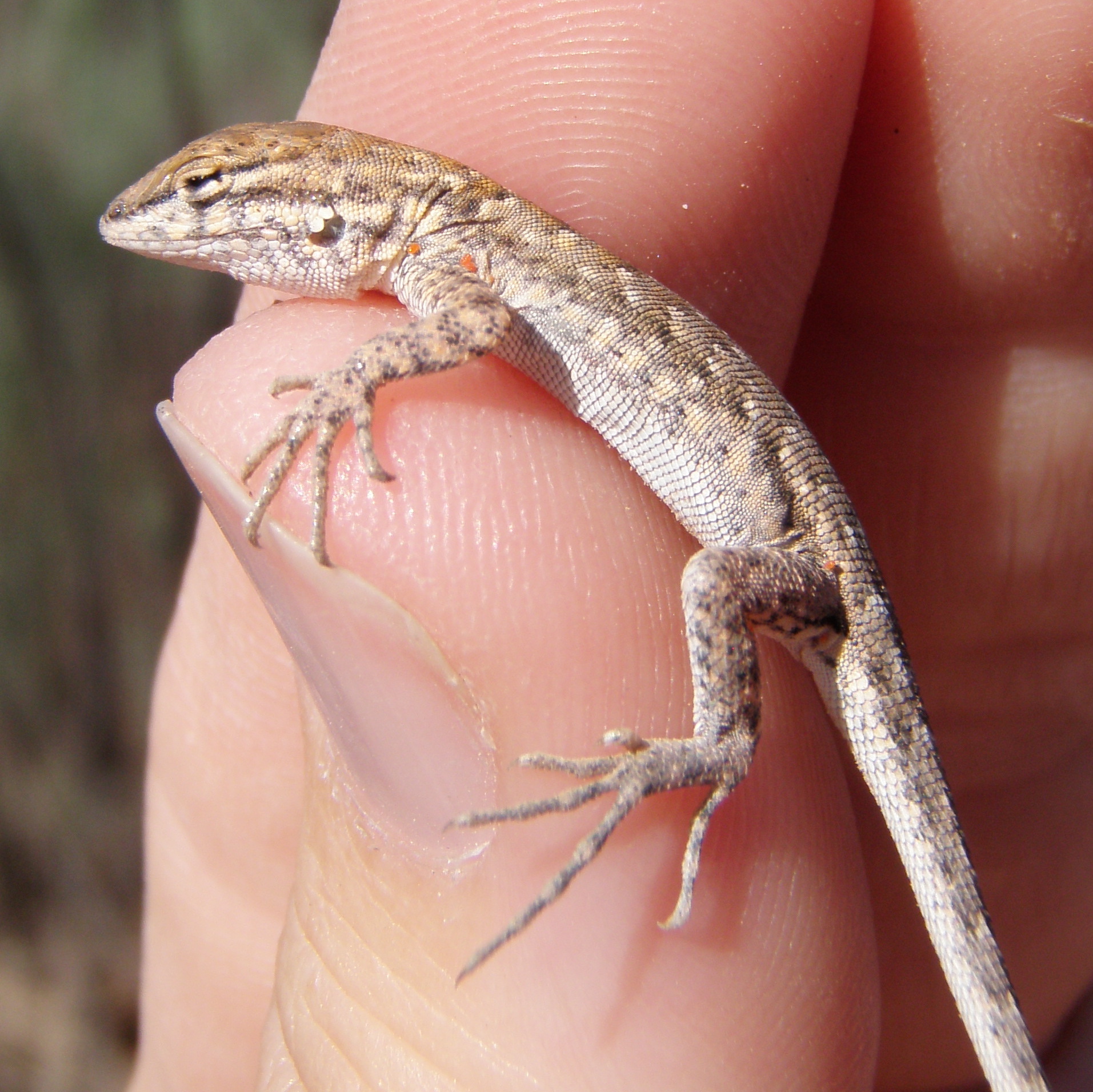
The Common Side-blotched Lizard

The Common Side-blotched Lizard

The activities are as follows:

Throughout history people have settled mainly along rivers and streams. Easy access to water provides resources to support many people living in one area. In the United States today, people have settled along 70% of rivers.

Today, rivers are very different from what they were like before people settled near them. The land surrounding these rivers, called riparian habitats, has been transformed into land for farming, businesses, or housing for people. This urbanization has caused the loss of green spaces that provide valuable services, such as water filtration, species diversity, and a connection to nature for people living in cities. Today, people are trying to restore green spaces along the river to bring back these services. Restoration of disturbed riparian habitats will hopefully bring back native species and all the other benefits these habitats provide.

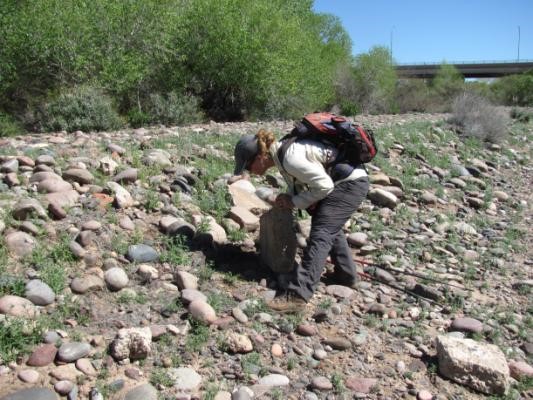
Scientist Mélanie searching for reptiles in the Central Arizona-Phoenix LTER.

Scientist Mélanie searching for reptiles in the Central Arizona-Phoenix LTER.

Scientists Heather and Mélanie are researchers with the Central Arizona-Phoenix Long-Term Ecological Research (CAP LTER) project. They want to know how restoration will affect animals living near rivers. They are particularly interested in reptiles, such as lizards. Reptiles play important roles in riparian habitats. Reptiles help energy flow and nutrient cycling. This means that if reptiles live in restored riparian habitats, they could increase the long-term health of those habitats. Reptiles can also offer clues about the condition of an ecosystem. Areas where reptiles are found are usually in better condition than areas where reptiles do not live.

Heather and Mélanie wanted to look at how disturbances in riparian habitats affected reptiles. They wanted to know if reptile abundance (number of individuals) and diversity (number of species) would be different in areas that were more developed. Some reptile species may be sensitive to urbanization, but if these habitats are restored their diversity and abundance might increase or return to pre-urbanization levels. The scientists collected data along the Salt River in Arizona. They had three sites: 1) a non-urban site, 2) an urban disturbed site, and 3) an urban rehabilitated site. They counted reptiles that they saw during a survey. At each site, they searched 21 plots that were 10 meters wide and 20 meters long. The sites were located along 7 transects, or paths measured out to collect data. Transects were laid out along the riparian habitat of the stream and there were 3 plots per transect. Each plot was surveyed 5 times. They searched for animals on the ground, under rocks, and in trees and shrubs.

Featured scientists: Heather Bateman and Mélanie Banville from Arizona State University. Written by Monica Elser from Arizona State University.

Flesch–Kincaid Reading Grade Level = 9.8

Check out this video of Heather and her lab out in the field collecting lizards:

Virtual field trip to the Salt River biodiversity project:

Additional resources related to this Data Nugget:

SaveSave

SaveSave

SaveSave

Is your salt marsh in the zone?

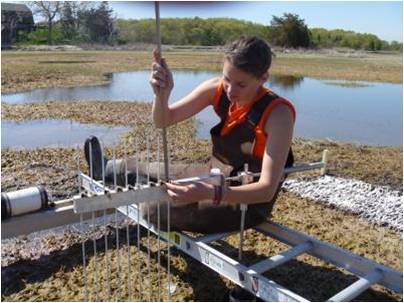
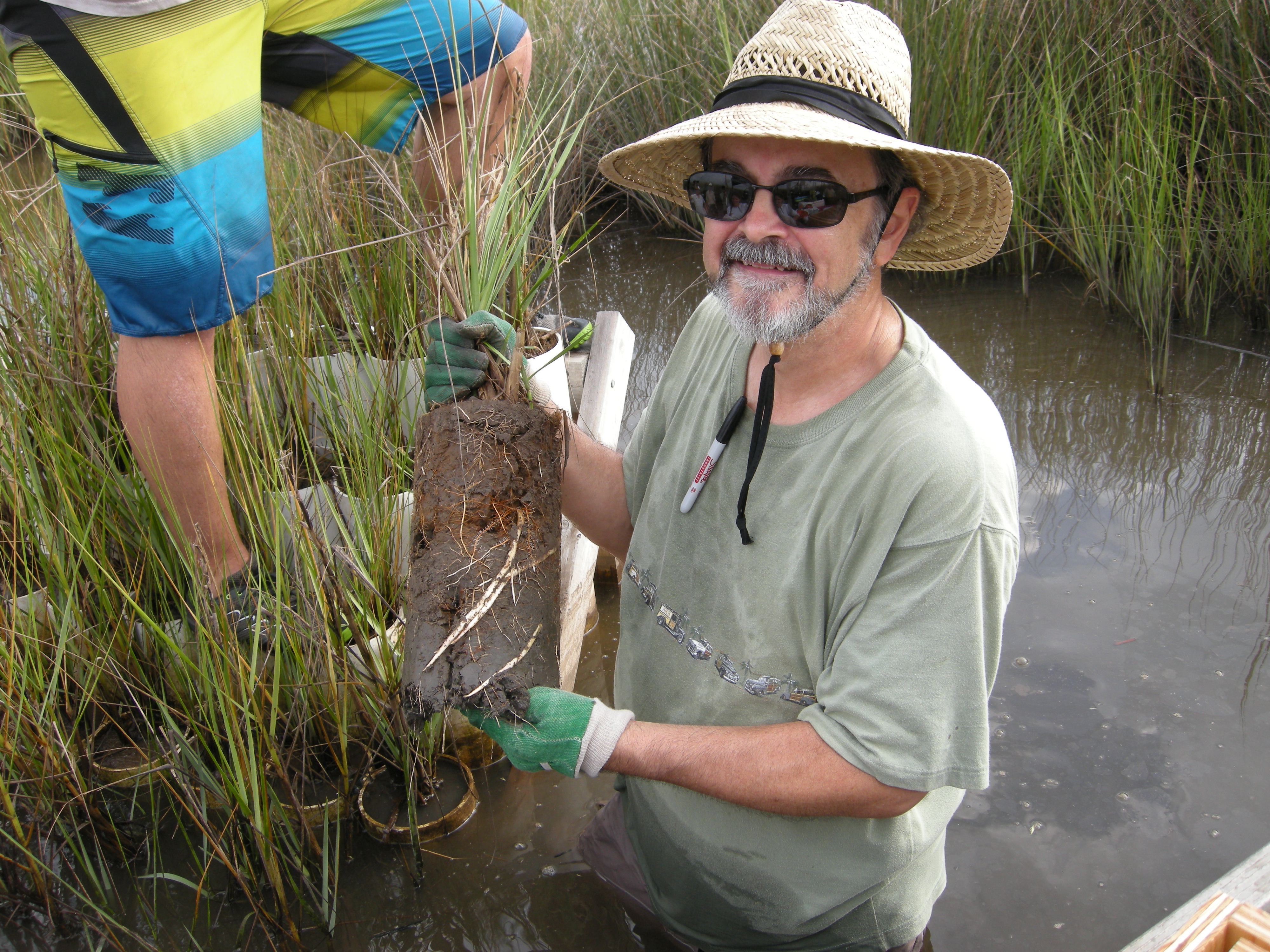
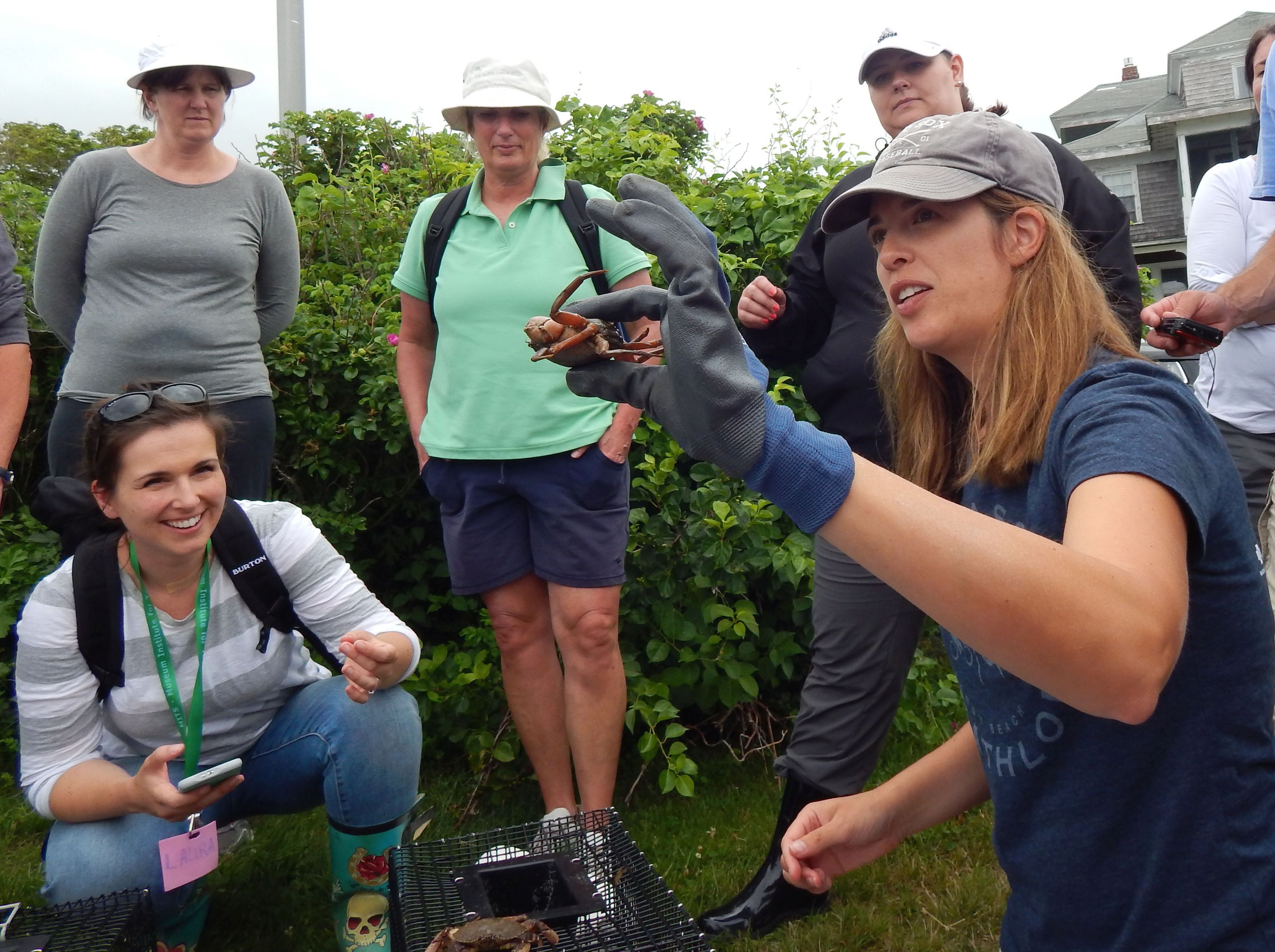
Scientist James collecting plants in a Massachusetts marsh, part of the Plum Island Ecosystems Long Term Ecological Research site

Scientist James collecting plants in a Massachusetts marsh, part of the Plum Island Ecosystems Long Term Ecological Research site

The activities are as follows:

Tides are the rise and fall of ocean water levels, and happen every day like clockwork. Gravity from the moon and sun drive the tides. There is a high tide and a low tide, and the average height of the tide is called the mean sea level. The mean sea level changes seasonally due to the warming and cooling of the ocean throughout the year. It also changes annually due to a long-term trend of ocean warming and the melting of glaciers. Scientific evidence shows that climate change is causing the sea level to rise faster now than it has in the past. As the climate continues to warm, it is predicted that the sea level will continue to rise.

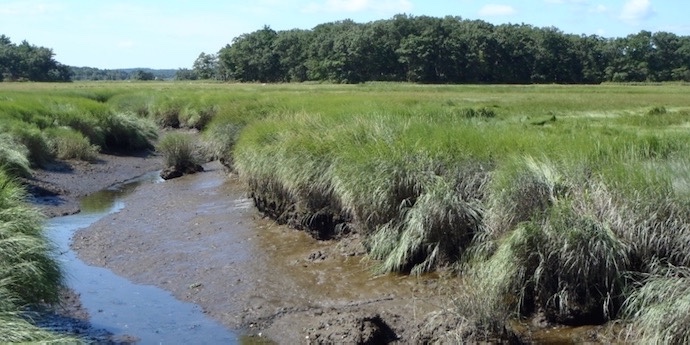
Salt marshes are wetlands with plains of grass that grow along much of the ocean’s coast worldwide. These marshes are important habitats for many plants and animals, and protect our shores from erosion during storms. They grow between mean sea level and the level of high tide. Marshes flood during high tide and are exposed to the air during low tide. The health of a salt marsh is determined by where it sits relative to the tide (the “zone”). A healthy marsh is flooded only part of the time. Too much flooding and too little flooding are unhealthy. Because they are so important, scientists want to know if salt marshes will keep up with sea level rise caused by climate change.

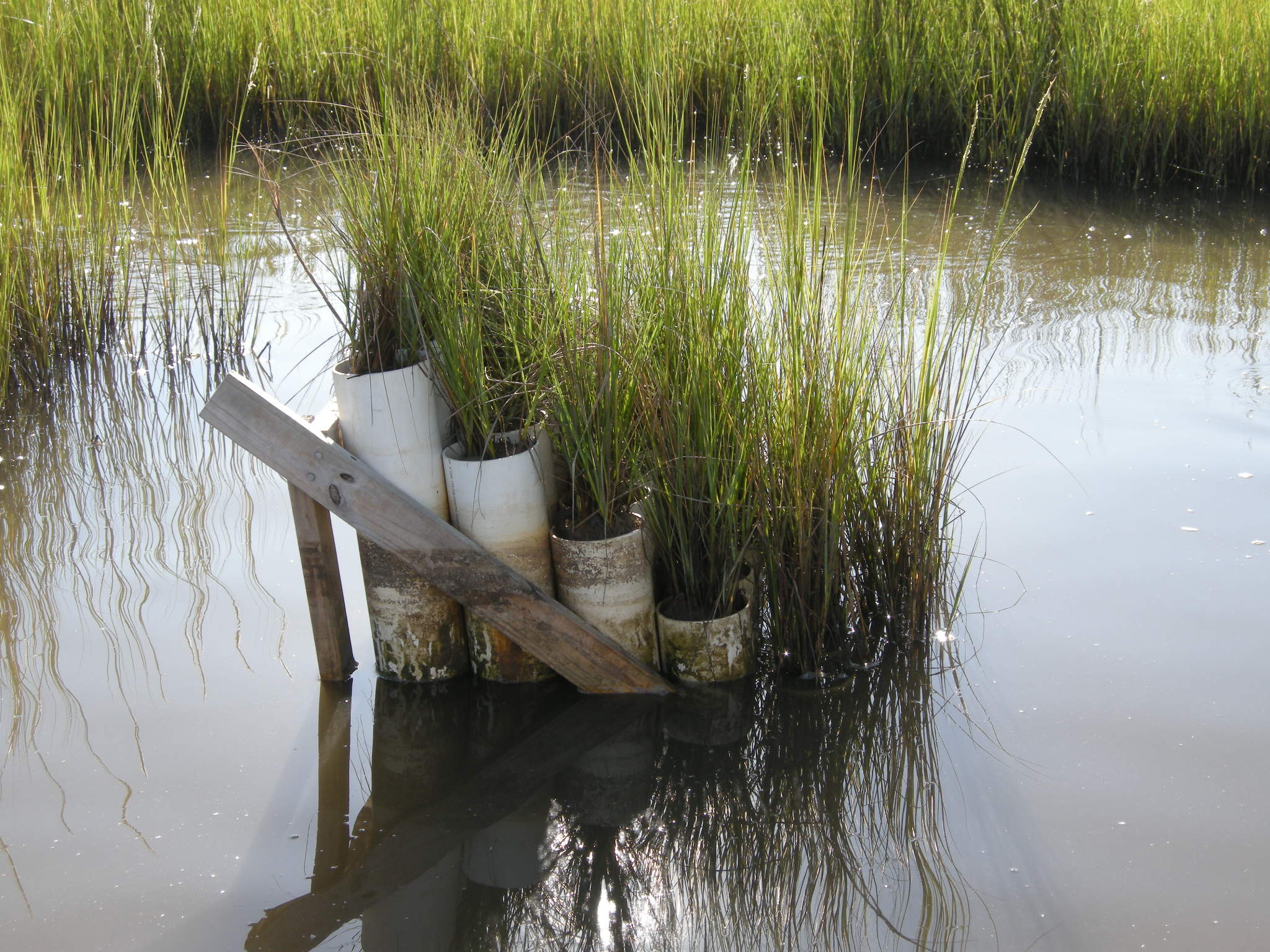
A picture of James’ “marsh organ” which holds plants at different elevations relative to mean sea level. He gave it that name because it resembles organ pipes!

A picture of James’ “marsh organ” which holds plants at different elevations relative to mean sea level. He gave it that name because it resembles organ pipes!

In the 1980s, scientist James began measuring the growth of marsh grasses. He was surprised to find that there was a long-term trend of increasing grass growth over the years. James wanted to know if grasses could continue to keep up with rising sea levels. If he could experimentally manipulate the height of the grasses, relative to mean sea level, he might be able to figure out how grasses will do when sea levels are higher. To test this, James invented a way to experimentally grow a marsh at different elevations relative to mean sea level. He built a device he called the “marsh organ”. This device is made of tubes that stand at different elevations and are filled with marsh mud and planted with marsh grasses. He measured the growth of the grass in each of the pipes. If grasses will continue to grow taller in the future with higher water levels, then plants growing in pipes at lower elevations should grow more than plants growing in pipes with higher elevations.

Featured scientist: James Morris from the University of South Carolina

Additional teacher resource related to this Data Nugget: Jim has created an interactive salt marsh model called the “marsh equilibrium model”. This online tool allows you to plug in different marsh levels to explore potential impacts to the salt marsh. To explore this tool click here.

To read more about Jim’s research on “tipping points” beyond which sediment accumulation fails to keep up with rising sea level and the marshes drown, click here.

There are two publications related to the data included in this activity:

  • Morris, J.T., Sundberg, K., and Hopkinson, C.S. 2013. Salt marsh primary production and its responses to relative sea level and nutrients in estuaries at Plum Island, Massachusetts, and North Inlet, South Carolina, USA. Oceanography 26:78-84.
  • Morris, J.T., P.V. Sundareshwar, C.T. Nietch, B. Kjerfve, D.R. Cahoon. 2002. Responses of coastal wetlands to rising sea level. Ecology 83:2869-2877.

SaveSave

Green crabs: invaders in the Great Marsh

Scientist Alyssa holding a non-native green crab, introduced from Europe to the American Atlantic Coast. This crab causes many problems in its new range, including the loss of native eelgrass.

Scientist Alyssa holding a non-native green crab, introduced from Europe to the American Atlantic Coast. This crab causes many problems in its new range, including the loss of native eelgrass.

The activities are as follows:

Marshes, areas along the coast that flood with each tide, are incredibly important habitats. They act as homes to large number of species, protect the coast from erosion during storms, and act as a filter for nutrients and pollution. Many species are unique to these habitats and provide crucial support to the marsh. For example, native eelgrass, a type of plant, minimizes erosion by holding sediments in place with their roots.

In an effort to help protect and restore marshes, we must understand current-day issues that are affecting their health. The introduction of non-native species, species that are not originally from this ecosystem, into a marsh may disrupt the marsh ecosystem and threaten the survival of native species. One species that has recently caused a lot of trouble is the European green crab. This crab species was accidentally carried to the Atlantic coast back in the early 1800s from Europe. Since then, they have become extremely invasive and their numbers have exploded! Compared to native crabs, the green crab digs a lot when it searches for food and shelter. This digging uproots eelgrass and causes its population numbers to fall. In many spots where green crabs have been introduced, marshes are now bare and no more grass can grow.

Non-native green crabs caught in trap that has been underwater for 25 hours

Non-native green crabs caught in trap that has been underwater for 25 hours

The Great Marsh is one of the coastal habitats affected by invasive green crabs. Located on the North Shore of Massachusetts, the Great Marsh is known for being the longest continuous stretch of salt marsh in all of New England. Alyssa is a restoration ecologist who is very concerned with the conservation of the Great Marsh and other important coastal ecosystems. She and other scientists are trying to maintain native species while also reducing the effects of non-native species.

A major goal for Alyssa is to restore populations of a native eelgrass. Eelgrass does more than just prevent erosion. It also improves water quality, provides food and habitat for native animal species, and acts as an indicator of marsh health. If green crabs are responsible for the loss of eelgrass from the marsh, then restorations where eelgrass is planted back into the marsh should be more successful where green crab numbers are low. Alyssa has been measuring green crab populations in different areas by laying out green crab traps for 24 hours. Alyssa has set these traps around Essex Bay, an area within the Great Marsh. She recorded the total number of green crabs caught at each location (as well as their body size and sex).

Native eelgrass growing in Essex Bay, an area within the Great Marsh

Native eelgrass growing in Essex Bay, an area within the Great Marsh

Featured scientist: Alyssa Novak, Center for Coastal Studies/Boston University. Written by: Hanna Morgensen

Flesch–Kincaid Reading Grade Level = 8.8

Urbanization and estuary eutrophication

Charles Hopkinson out taking dissolved O2 measurements.

Charles Hopkinson out taking dissolved O2 measurements.

The activities are as follows:

An estuary is a habitat formed where a freshwater river or stream meets a saltwater ocean. Many estuaries can be found along the Atlantic coast of North America. Reeds and grasses are the dominant type of plant in estuaries because they are able to tolerate and grow in the salty water. Where these reeds and grasses grow they form a special habitat called a salt marsh. Salt marshes are important because they filter polluted water and buffer the land from storms. Salt marshes are the habitat for many different kinds of plants, fish, shellfish, and birds.

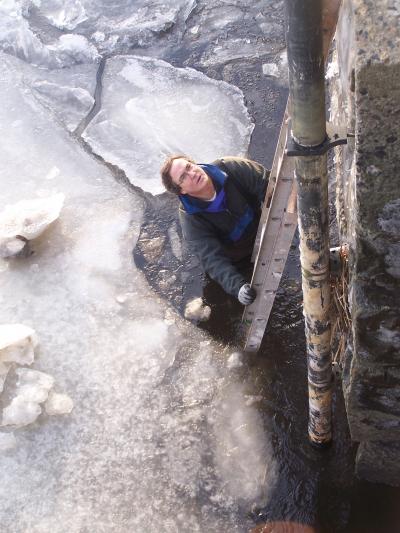
Hap Garritt removing an oxygen logger from Middle Road Bridge in winter.

Hap Garritt removing an oxygen logger from Middle Road Bridge in winter.

Scientists are worried because some salt marshes are in trouble! Runoff from rain washes nutrients, usually from lawn fertilizers and agriculture, from land and carries them to estuaries. When excess nutrients, such as nitrogen or phosphorus, enter an ecosystem the natural balance is disrupted. The ecosystem becomes more productive, called eutrophication. Eutrophication can cause major problems for estuaries and other habitats.

With more nutrients in the ecosystem, the growth of plants and algae explodes. During the day, algae photosynthesize and release O2 as a byproduct. However, excess nutrients cause these same algae grow densely near the surface of the water, decreasing the light available to plants growing below the water on the soil surface. Without light, the plants die and are broken down by decomposers. Decomposers, such as bacteria, use a lot of O2 because they respire as they break down plant material. Because there is so much dead plant material for decomposers, they use up most of the O2 dissolved in the water. Eventually there is not enough O2 for aquatic animals, such as fish and shellfish, and they begin to die-off as well.

Two features can be used to identify whether eutrophication is occurring. The first feature is low levels of dissolved O2 in the water. The second feature is when there are large changes in the amount of dissolved O2 from dawn to dusk. Remember, during the day when it’s sunny, photosynthesis converts CO2, water, and light into glucose and O2. Decomposition reverses the process, using glucose and O2 and producing CO2 and water. This means that when the sun is down at night, O2 is not being added to the water from photosynthesis. However, O2 is still being used for decomposition and respiration by animals and plants at night.

The scientists focused on two locations in the Plum Island Estuary and measured dissolved O2 levels, or the amount of O2 in the water. They looked at how the levels of O2 changed throughout the day and night. They predicted that the upper part of the estuary would show the two features of eutrophication because it is located near an urban area. They also predicted the lower part of the estuary would not be affected by eutrophication because it was farther from urban areas.

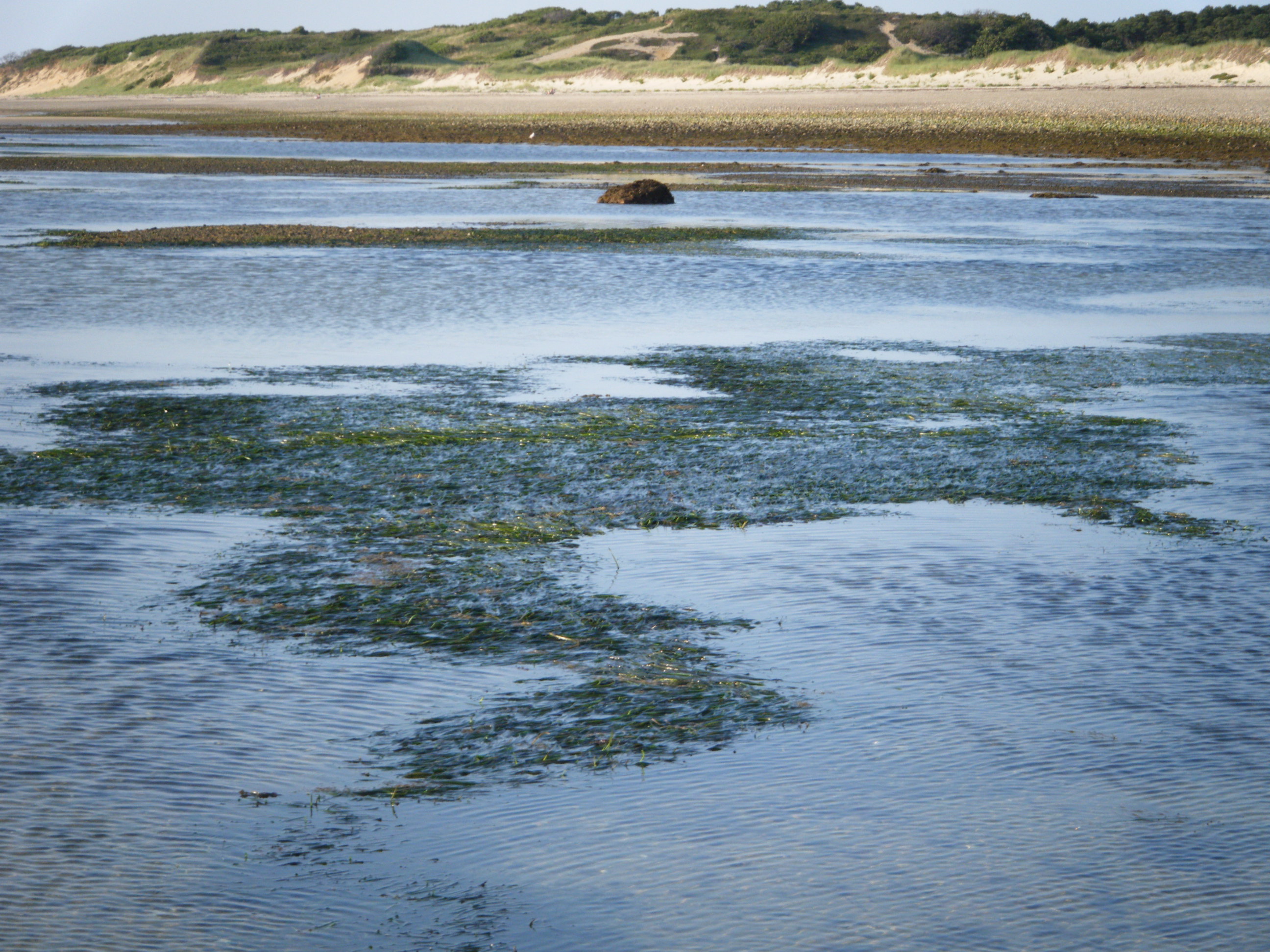
A view of the Plum Island estuary

A view of the Plum Island estuary

Featured scientists: Charles Hopkinson from University of Georgia and Hap Garritt from the Marine Biological Laboratory Ecosystems Center

Flesch–Kincaid Reading Grade Level = 9.6

Invasive reeds in the salt marsh

Culverts run under roads and allow water from the ocean to enter a marsh. Phragmites can be seen growing in the background.

Culverts run under roads and allow water from the ocean to enter a marsh. Phragmites can be seen growing in the background.

The activities are as follows:

Phragmites australis is an invasive reed, a type of grass that grows in water. Phragmites is taking over saltwater marshes in New England, or wetland habitats near the Atlantic Ocean coast. Phragmites does so well it crowds out native plants that once served as food and homes for marsh animals. Once Phragmites has invaded, it is sometimes the only plant species left! Phragmites does best where humans have disturbed a marsh, and scientists were curious why that might be. They thought that perhaps when a marsh is disturbed, the salinity, or amount of salt in the water, changes. Phragmites might be able to survive after disturbances that cause the amount of salt in the water to drop, but becomes stressed when salinity is high.

Students collecting data on the plant species present in the marsh using transects. Every 1m along the tape, students observe which plants are present. Phragmites is the tall grass that can be seen growing behind the students.

Students collecting data on the plant species present in the marsh using transects. Every 1m along the tape, students observe which plants are present. Phragmites is the tall grass that can be seen growing behind the students.

Fresh water in a marsh flows from the upstream source to downstream. Saltwater marshes end at the ocean, where freshwater mixes with salty ocean water. One type of disturbance is when a road is cut through a marsh. Upstream of the road, the marsh is cut off from the salt waters from the ocean, so only fresh water will enter and salinity will drop. Downstream of the road, the marsh is still connected to the ocean and salinity should be unaffected by the disturbance. Often, a culvert (a pipe that runs under the road) is placed to allow salt water to pass from the ocean into the marsh. The amount of ocean water flowing into the marsh is dependent on the diameter of the culvert.

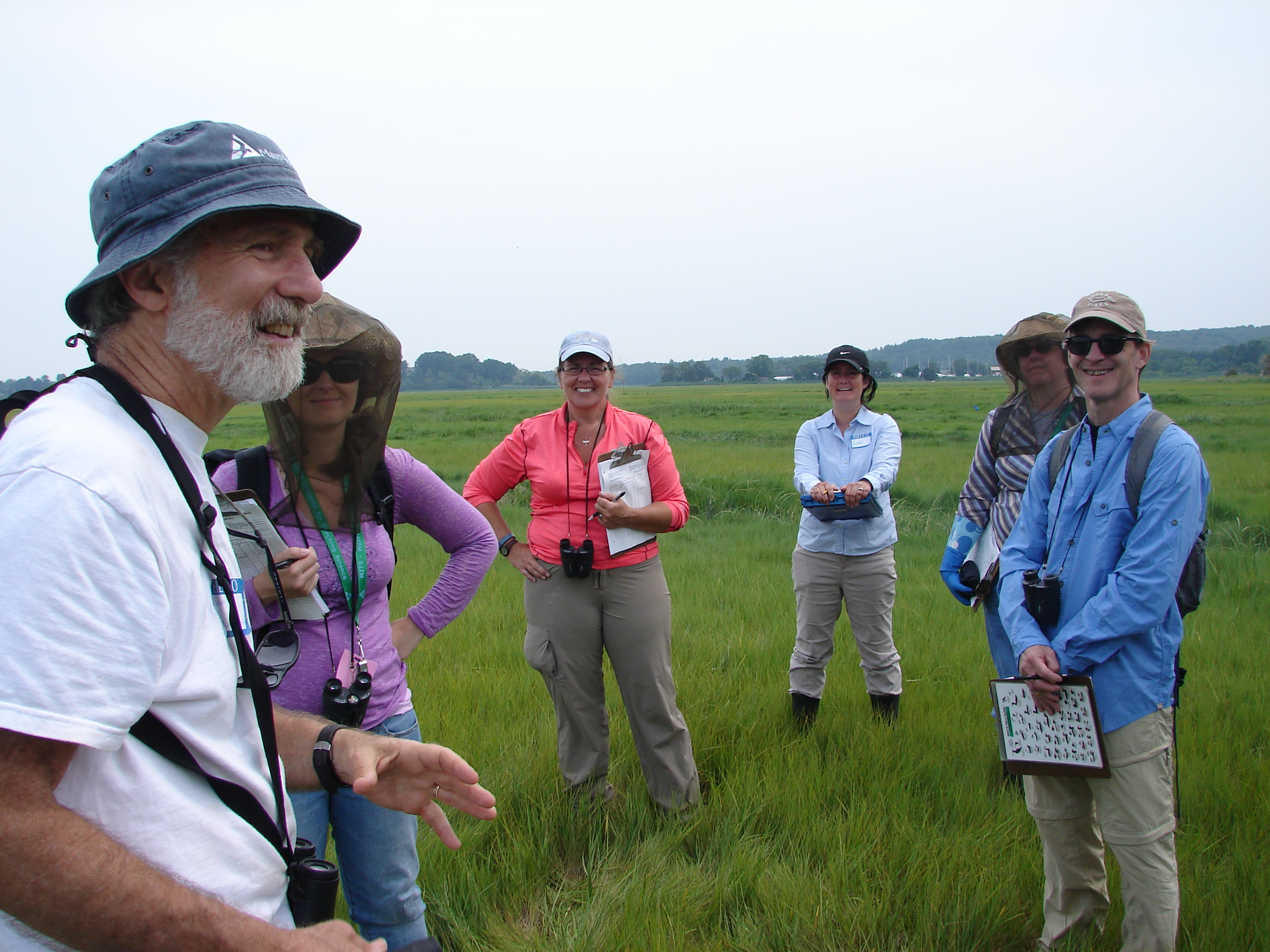
Students at Ipswich High School worked with scientists from the Mass Audubon, a conservation organization, to look at the Phragmites in the marsh. They looked at an area where the salinity in the marsh changed after a road was built. They wanted to know if this change would affect the amount of Phragmites in that marsh. In 1996, permanent posts were placed 25 meters apart in the marsh. That way, scientists could collect data from the same points each year. At these posts, students used transects, a straight line measured from a point to mark where data is collected. Then they collected data on all the plants that were found every meter along the transects. Data has been collected at these same points since 1996. In 2005, an old 30cm diameter culvert was replaced with two 122cm culverts. These wider culverts allow much more salty ocean water to flow under the road and into the marsh. Students predicted that after the culverts were widened, more ocean water would enter the marsh. This would make salinity go up, making it harder for Phragmites to grow, and it would decline in numbers. Students continued to survey the plants found along transects at each permanent post and documented their findings.

Featured scientists: Lori LaFrance from Ipswich High School, Massachusetts and Liz Duff from Mass Audubon. This study was part of the PIE-LTER funded by the NSF.

Flesch–Kincaid Reading Grade Level = 9.0

To access the original data presented in this activity, and collected by students, access Mass Audubon’s Vegetation Data, available online. To access the salinity data related to this activity, and collected by students, access Mass Audubon’s Salinity Data, available online. Scroll down to “Ipswich, MA, Town Farm Road” for data from the site discussed here.

View of the two new culverts.

View of the two new culverts.

The old pipe that was removed.

The old pipe that was removed, and the new culvert.


Arial view of the upstream and downstream research sites.

Arial view of the upstream and downstream research sites.

Growing energy: comparing biofuel crop biomass

The activities are as follows:GLBRC1

Éste Data Nugget también está disponible en Español:

Most of us use fossil fuels every day to power our cars, heat and cool our homes, and make many of the products we buy. Fossil fuels like coal, oil, and natural gas come from plants and animals that lived and died hundreds of millions of years ago – this is why they’re called “fossil” fuels! These ancient energy sources have many uses, but they also have a major problem. When we use them, fossil fuels release carbon dioxide into the atmosphere. As a greenhouse gas, carbon dioxide traps heat and warms the planet. To avoid the serious problems that come with a warmer climate, we need to transition away from fossil fuels and think of new, cleaner ways to power our world.

Biofuels are one of these alternatives. Biofuels are made out of the leaves and stems (called biomass) of plants that are alive and growing today. When harvested, the biomass can be converted into fuel. Plants take in carbon dioxide from the atmosphere to grow. It’s part of the process of photosynthesis. In that way, biofuels can create a balance between the carbon dioxide taken in by plants and what is released when burning fuels.

GLBRC2

At the Great Lakes Bioenergy Research Center, scientists and engineers work together to study how to grow plants that take in as much carbon as possible while also producing useful biofuels. Gregg is one of these scientists and he wants to find out how much biomass can be harvested from different plants like corn, grasses, trees, and even weeds. Usually, the bigger and faster a plant grows, the more biomass they make. When more biomass is grown, more biofuels can be produced. Gregg is interested in learning how to produce the most biomass while not harming the environment.

While biofuels may sound like a great solution, Gregg is concerned with how growing them may affect the environment. Biofuels plants come with tradeoffs. Some, like corn, are great at quickly growing to huge heights – but to do this, they often need a lot of fertilizer and pesticides. These can harm the environment, cost farmers money, and may even release more of the greenhouse gasses we are trying to reduce. Other plants might not grow so fast or so big, but also don’t require as many chemicals to grow, and can benefit the environment in other ways, such as by providing habitat for animals. Many of those plants are perennials, meaning that they can grow back year after year without replanting (unlike corn). Common biofuel perennials like switchgrass, Miscanthus grass, prairie grasses, and poplar trees require fewer fertilizers and pesticides to grow, and less fossil fuel-powered equipment to grow and harvest them. Because of this, perennials might be a smart alternative to corn as a source of biofuels.

Gregg out in the GLBRC

Gregg out in the WI experimental farm.

Believing in the power of perennials, Gregg thought that it might even be possible to get the same amount of biomass from perennials as is normally harvested from corn, but without using all of the extra chemicals and using less energy. To investigate his ideas, Gregg worked together with a team to design a very big experiment. The team grew many plots of biofuel plants on farms in Wisconsin and Michigan, knowing that the soils at the site in Wisconsin were more nutrient-rich and better for the plants they were studying than at the Michigan site. At each farm, they grew plots of corn, as well as five types of perennial plots: switchgrass, Miscanthus grass, a mix of prairie plant species, young poplar trees, and weeds. For five years, the scientists harvested, dried, and weighed the biomass from each plot every fall. Then, they did the math to find the average amount of biomass produced every year by each plot type at the Wisconsin and Michigan sites.

Featured scientist: Dr. Gregg Sanford from University of Wisconsin-Madison. Written with Marina Kerekes.

Flesch–Kincaid Reading Grade Level = 8.9

This Data Nugget was adapted from a data analysis activity developed by the Great Lakes Bioenergy Research Center (GLBRC). For a more detailed version of this lesson plan, including a supplemental reading, biomass harvest video and extension activities, click here.

This lesson can be paired with The Science of Farming research story to learn a bit more about the process of designing large-scale agricultural experiments that need to account for lots of variables.

For a classroom reading, click here to download an article written for the public on these research findings. Click here for the scientific publication. For more bioenergy lesson plans by the GLBRC, check out their education page.

Aerial view of GLBRC KBS LTER cellulosic biofuels research experiment; Photo Credit: KBS LTER, Michigan State University

Aerial view of GLBRC KBS LTER cellulosic biofuels research experiment; Photo Credit: KBS LTER, Michigan State University

For more photos of the GLBRC site in Michigan, click here.

logo

SaveSave

SaveSave

SaveSave

SaveSave

SaveSave

SaveSaveSaveSave

SaveSave

SaveSave

SaveSave

Springing forward

Scientist Shaun collecting phenology data in the climate change experiment. He is recording the date that the first flowers emerge for dame’s rocket.

Sean Mooney, a high school researcher, collecting phenology data in the climate change experiment. He is recording the date that the first flowers emerge for dame’s rocket.

The Reading Level 1 activities are as follows:

The Reading Level 3 activities are as follows:

Éste Data Nugget también está disponible en Español:

Every day we add more greenhouse gases to our air when we burn fossil fuels like oil, coal, and natural gas. Greenhouse gasses trap the sun’s heat, so as we add more the Earth is heating up! What does climate change mean for the species on our planet? The timing of life cycle events for plants and animals, like flowering and migration, is largely determined by cues organisms take from the environment. The timing of these events is called phenology. Scientists studying phenology are interested in how climate change will influence different species. For example, with warming temperatures and more unpredictable transitions between seasons, what can we expect to happen to the migration timings of birds, mating seasons for animals, or flowering times of plants?

Scientists collecting phenology data in the climate change experiment. They are recording the date that the first flowers emerge for dame’s rocket.

Scientists collecting phenology data in the climate change experiment.

Plants are the foundation for almost all life on Earth. Through photosynthesis, plants produce the oxygen (O2) that we breathe, food for their own growth and development, food for animals and microbes, and crops that provide food and materials for human society. Because plants are so important to life, we need to find out how climate change could affect them. One good place to start is by looking at flowering plants, guided by the question, how will increased temperatures affect the phenology of flowering? One possible answer to this question is that the date that flowers first emerge for a species is driven by temperature. If this relationship is real, we would expect flowers to emerge earlier each year as temperatures increase due to climate change. But if flowers come out earlier and earlier each year, this could greatly impact plant reproduction and could cause problems for pollinators who count on plants flowering at the same time the pollinators need the pollen for food.

Shaun, Mark, Elizabeth, and Jen are scientists in Michigan who wanted to know if higher temperatures would lead to earlier flowering dates for plants. They chose to look at flowers of dame’s rocket, a leafy plant that is related to the plants we use to make mustard! Mark planted dame’s rocket in eight plots of land. Plots were randomly assigned to one of two treatments. Half of the plots were left to experience normal temperatures (normal), while the other four received a heating treatment to simulate climate change (heated). Air temperatures in heated plots increased by 3°C, which mimics climate change projections for what Michigan will experience by the end of the century. Mark, Elizabeth, and Jen measured the date that each plant produced its first flower, and the survival of each plant. The scientists predicted that dame’s rocket growing in the heated plots would flower earlier than those in the normal plots.

 Featured scientists: Shaun Davis from Thornapple Kellogg Middle School and Mark Hammond, Elizabeth Schultheis, and Jen Lau from Michigan State University

Flesch–Kincaid Reading Grade Level = The Reading Level 3 activity has a score of 9.2; the Level 1 has a 6.4.

Flowers of Hesperis matronalis (dame’s rocket), a species of mustard that was introduced to the U.S. from Eurasia.

Flowers of Hesperis matronalis (dame’s rocket), a species of mustard that was introduced to the U.S. from Eurasia.

Additional teacher resources related to this Data Nugget include:

  • If you would like your students to interact with the raw data, we have attached the original data here. The file also includes weather data over the course of the experiment if students want to ask and explore independent questions.

SaveSave

SaveSave

SaveSave

SaveSave

SaveSave

SaveSave

SaveSave

SaveSave

SaveSave

SaveSave

SaveSave

Shooting the poop

The activities are as follows:butterfly

Imagine walking through a forest in the middle of summer. You can hear birds chirping, a slight breeze rustling the leaves, and a faint pinging noise like rain. However, what you hear is not rain – it is the sound of millions of forest insects pooping!

If we look closer to see who is making all this frass (insect poop) you’ll notice there are tons of caterpillars amongst the leaves. You might see caterpillars eating plants and hiding from predators. Some caterpillars might camouflage themselves, while others build shelters from leaves to avoid being seen. Others are brightly colored to warn predators that they have chemicals that make them taste awful.

The silver-spotted skipper is a caterpillar that lives in the forest. They have a variety of defense strategies against enemies, including building leaf shelters for protection. For these insects, the sight and smell of poop might alert predators that there is a tasty meal nearby. Usually caterpillars keep moving and leave their frass behind, but this species builds shelters and isn’t able to keep moving because they need their shelters for protection.

Martha is a behavioral biologist who studies these insects. While raising silver-spotted skipper caterpillars in the lab, Martha noticed that they were making a pinging noise in their containers. Upon further observation, she discovered that they “shoot their poop”, sometimes launching their frass over 1.5m! Martha wanted to figure out why these caterpillars might have this very strange behavior. Perhaps launching their frass is a way to avoid being found by predators.

To evaluate whether the smell of frass helps predators find and locate silver-spotted skippers, Martha conducted an experiment with a wasp predator that eats these caterpillars. She allowed two silver-spotted skippers to build shelters on a leaf and then carefully removed the caterpillars. She then inserted 6 frass pellets into one of the shelters, and 6 beads designed to look like frass but with no smell (control treatment) into the other shelter. She placed the leaf with the two shelters in a cage containing an actively foraging wasp colony (n = 10 wasps). She recorded how many times the wasps visited each shelter (control beads or frass) and how much time the wasps spent exploring each shelter. She expected wasps would spend more time exploring the shelters with the frass than they would the control shelters.

Featured scientist: Martha Weiss from Georgetown University. Written by Kylee Grenis.

Flesch–Kincaid Reading Grade Level = 9.6

Additional teacher resources related to this Data Nugget include:

YouTube videos of the silver-spotted skipper (Epargyreus clarus) “shooting its poop” (aka. ballistic defecation). These videos would be great to show in class after students have read the Research Background section to help engage them with the system.

SaveSave

SaveSave

SaveSave

SaveSave

SaveSave

SaveSave

SaveSaveSaveSave

SaveSave