Blinking out?

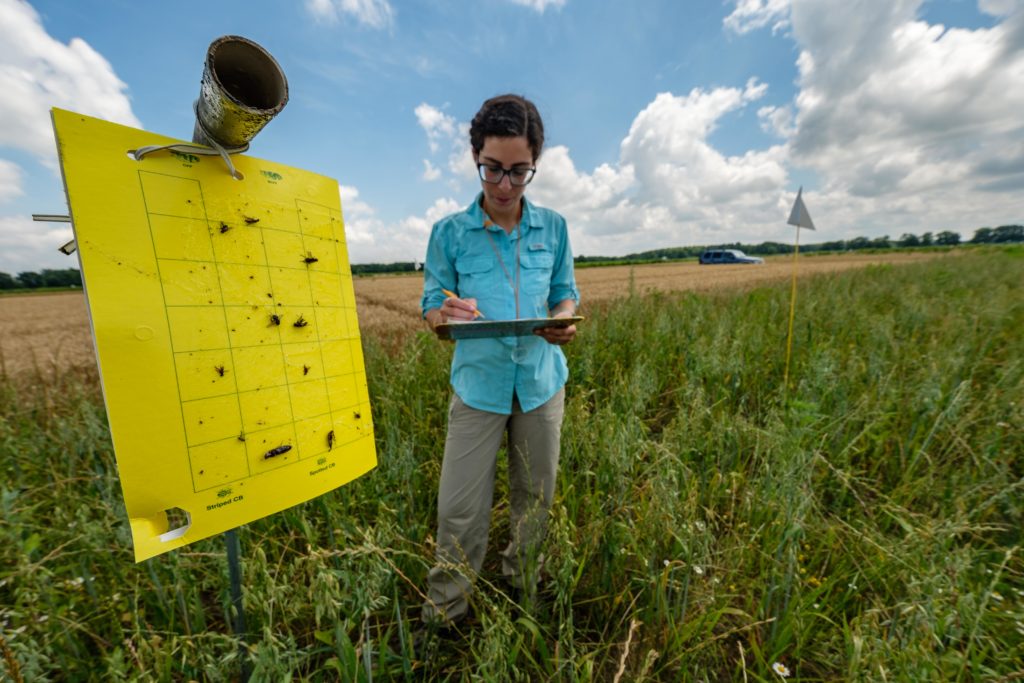
A researcher collects data from a yellow sticky card at the MSU KBS LTER site. Photo Credit: K. Stepnitz, Michigan State University.

The activities are as follows:

The longest surveys of fireflies known to science was actually started by accident!

At the Kellogg Biological Station Long-Term Ecological Research Site, scientists work together to answer questions that can only be studied with long-term data. Their focus is to collect data in the same way over many consecutive years to look for patterns through time. One of these long-term studies, looking at lady beetle populations, was developed to keep watch on these important species. To count lady beetles, scientists placed yellow sticky card traps out in the same plots year after year. These data are used to figure out if lady beetle numbers are changing over time.

Because sticky traps catch everything small that flies by, other insect species get stuck as well. One day, a research technician noticed this and decided to add a few new columns to the data sheet. That way they could start recording data on the other insect species found on the sticky traps. Each year the technician kept adding to the record and over time, more and more data were collected. One of those new columns happened to record the number of fireflies caught. Though the exact reason for this data collection is lost to history, scientists quickly realized the value of this dataset! 

Several years later, Julia became the lab technician. She took over the responsibility of the sticky trap count, adding to the dataset. Christie joined this same lab as a scientist and stumbled upon the data on fireflies that Julia and the previous technician had collected. She wanted to take advantage of the long-term data and analyze whether firefly populations had been increasing or decreasing. 

Many people have fond memories of watching fireflies blink across open fields and collecting them in jars as children. This is one of the reasons why fireflies are a beloved insect species. Julia grew up in southwest Michigan and fondly recalls spending summers watching them blink over yards and open fields, catching them in jars to watch them for a little while. Christie did the same in her parent’s yard in rural Ontario! That fondness never really went away and both enjoy watching the fireflies around Northeast Ohio where they currently live. Fireflies are also an important part of the ecosystems where they live. Larvae spend most of their time in the soil and are predators of insects and other small animals, such as snails. 
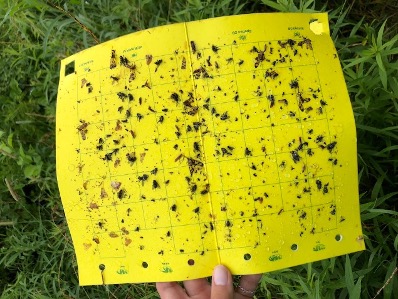
All the insects collected on a yellow sticky card trap over the course of one week. Photo credit: Elizabeth D’Auria, Michigan State University.

Many scientists and citizens alike have noticed that they aren’t seeing as many fireflies as they used to. Habitat loss and light pollution could be causing problems for fireflies. This is where the importance of long-term data really comes into play. Long-term data are critical to identifying and understanding natural population cycles over long periods of time that we wouldn’t be able to see with just a few years of data. It also gives scientists opportunities to answer unanticipated research questions. In this situation, even though the data were collected without a specific purpose in mind, having the dataset available offered new opportunities! Christie and Julia were able to look at the long-term changes in southwest Michigan firefly populations, something they would not have been able to do before the research technician added those extra columns. In order to start answering this question, they compiled all of the years of firefly data and began to compare the average counts from year to year. Although data were collected in multiple different habitat types, they focused on data from open fields because fireflies use these areas to find mates.

Featured scientists: Christie Bahlai and Julia Perrone from Kent State University. Data from the Kellogg Biological Station Long Term Ecological Research Program – KBS LTER

Flesch–Kincaid Reading Grade Level = 10.7

Additional teacher resources related to this Data Nugget include:

Purring crickets: The evolution of a new cricket song

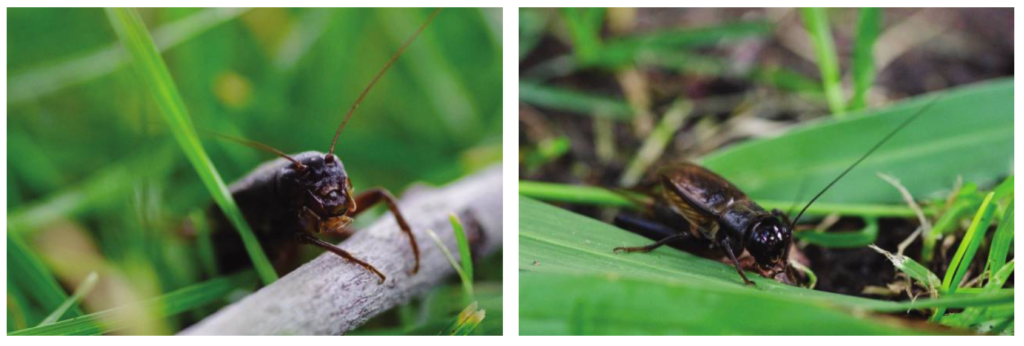
Robin’s team recording purring and typical cricket songs in the field. They analyzed the recordings and discovered that purring was a new song.

The activities are as follows:

Animals use many types of mating signals to attract mates. Some of these signals are probably familiar to you, like the bright colors of birds’ feathers, complex courtship dances of fish, and loud calls of frogs. In crickets, males rub their wings together to produce chirping mating songs that attract females. However, in one species of cricket, these mating songs have led to an issue – while they attract females towards the male, they also attract parasitoid flies. These flies kill the crickets by eating them from the inside out! Parasitoids are animals that lay their eggs in another organism’s body. The eggs develop and usually kill the host.

About twenty years ago, scientists discovered male Pacific field crickets in several spots in Hawaii had stopped making songs. By looking at their wings and DNA, scientists were able to find the exact genetic mutation causing their silence. This change in DNA made some crickets to grow with flat wings that made no sound. Males with this mutation are able to escape detection by the parasitoid flies. However, being silent also posed a struggle because flat winged males could no longer use songs to attract female mates. Scientists waited and watched – would a new way to attract females evolve over time, one that is audible to females, but not to the flies?

Robin is a scientist who has been studying the mating signals in these crickets for many years. One summer, Robin was working in Hawaii and brought a Tupperware container full of crickets into her room. Suddenly, she heard what sounded like a purring cat, but there was no cat in sight. She soon realized the sound was coming from her container of crickets. This song was unlike anything ever observed before in crickets. 

Robin thought that this purring song might be the beginning of the evolution of a novel signal that could be detected by female crickets. If purring is a mating signal, female crickets should have a positive response to purring songs. One way to test this idea is to observe whether females move towards a purring song.

She set out to test her hypothesis with phonotaxis experiments in the lab. During phonotaxis experiments, scientists observe how an organism moves with respect to different sounds. In their first experiment, Robin and her colleagues placed a female at the center of an arena and played a purring song through 1 of 4 speakers. The other 3 speakers were silent. To document the female’s willingness to mate, Robin recorded if the female moved toward the purring and which speakers they contacted. If the purring song was not a mating signal, it should not be attractive to the females and she expected them to contact the speakers at random. This would mean that the purring speaker should be contacted 25% of the time (since only 1 of the 4 speakers broadcast purring). If the purring song was a mating signal, she expected female crickets to contact purring speakers more than 25% of the time.

In a second experiment, Robin investigated whether female crickets prefer purring songs as much as typical mating songs. Using the same set-up, she played either a typical or purring song through 1 of 4 speakers. If females moved toward the speaker playing a  song before the silent ones, she recorded the search time. Search time was calculated as the time it took the female to contact the broadcasting speaker minus the time at which the crickets started looking for the speaker. To see whether the purring song was evolving as a mating signal, she compared the time it took crickets to find speakers broadcasting the purring song compared to the typcal mating song. She predicted that if females still preferred the typical song more than the new song, that they would have longer search times for purring versus typical songs.

Left, a purring male from Moloka’i. Right, a purring male singing to attract mates. Photo credit: E. Dale Broder.

Featured scientist: Robin Tinghitella from The University of Denver.Written by: Gabrielle Welsh

Flesch–Kincaid Reading Grade Level = 9.3

Additional teacher resources related to this Data Nugget include:

To reflect, or not to reflect, that is the question

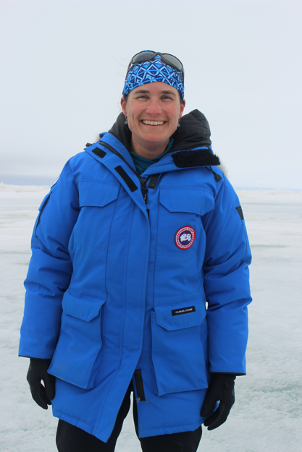
Jen stops to take a photo while conducting fieldwork in the Arctic.

The activities are as follows:

Since 1978, satellites have measured changes in Arctic sea ice extent, or the area by the North Pole covered by ice. Observations show that Arctic sea ice extent change throughout the year. Arctic sea ice reaches its smallest size at the end of summer in September. Scientists who look at these data over time have noticed the sea ice extent in September has been getting smaller and smaller since 1978. This shocking trend means that the Arctic sea ice is declining, and fast! 

Why does this matter? Well, it turns out that Arctic sea ice plays a major role in the world’s climate system. When energy from the Sun reaches Earth, part of the energy is absorbed by the surface, while the rest is reflected back into space. The energy that is absorbed becomes heat, and warms the planet. The amount of energy reflected back is called albedo.

The higher the albedo, the more energy is reflected off a surface. Complete reflection is assigned a value of 1 (100%) and complete absorption is 0 (0%). Lighter colored surfaces (e.g., white) have a higher albedo than darker colored surfaces (e.g., black). Sea ice is white and reflects about 60% of solar energy striking its surface, so its albedo measurement is 0.60. This means that 40% of the Sun’s energy that reaches the sea ice is absorbed. In contrast, the ocean is much darker and reflects only about 6% of the Sun’s energy striking its surface, so its albedo measurement 0.06. This means that 94% of the Sun’s energy that reaches the ocean is absorbed.

Jen (second from left) preparing to teach her students at the University of Colorado Boulder while working in the Arctic. Photo by Polar Bears International.

Jen first became interested in sea ice in the summer of 2007, when a record low level of sea ice caught scientists off guard. They worried that if the albedo of the Arctic declines, energy that used to be reflected by the white ice will be absorbed by the dark oceans and lead to increased warming. At the time, Jen was working with new satellite observations and found it fascinating to understand what led to the record low sea ice year. To continue her passion, Jen joined a team of scientists studying the Arctic’s energy budget. 

Jen and her team predicted that the decline in the light-colored sea ice will cause Arctic albedo to decrease as well. Jen used incoming and reflected solar energy data to determine the changes in the Arctic’s albedo. These data were collected from satellites as part of the Clouds and Earth’s Radiant Energy System (CERES) project. Then, Jen compared the albedo data to changes in the extent of sea ice from satellite images to look for a pattern. 

Featured scientist: Jen Kay from the Cooperative Institute for Research in Environmental Sciences and the Department of Atmospheric and Oceanic Sciences at the University of Colorado Boulder. Written by Jon Griffith with support from AGS 1554659 and OPP 1839104.

Flesch–Kincaid Reading Grade Level = 9.6

Fertilizer and fire change microbes in prairie soil

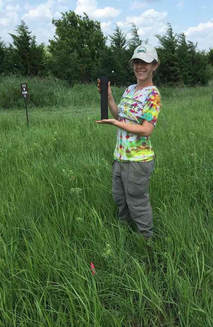
Christine collecting samples from the experimental plots to measure root growth.

The activities are as follows:

Stepping out into a prairie feels like looking at a sea of grass, with the horizon evoking a sense of eternity. Grasses and other prairie plants provide important benefits, such as creating habitat for many unique plants, mammals, insects, and microbes. They also help keep our water clean by using nutrients from the soil to grow. When plants take up these nutrients, they prevent them from going into streams. High levels of plant growth also keeps carbon bound up in the bodies of plants instead of in the atmosphere.  

Prairies grow where three environmental conditions come together – a variable climate, frequent fires, and large herbivores roaming the landscape. However, prairies are experiencing many changes. For example, people now work to prevent fires, which allows forest species to establish and eventually take over the prairie. In addition, a lot of land previously covered in prairie is now being used for agriculture. When land is used for agriculture, farmers add nutrients through fertilizer. With all these changes, prairie ecosystems have been declining globally. Scientists are concerned that as they disappear so will the benefits they provide. 

Lydia and Christine are two scientists contributing to the effort to learn more about how to preserve prairies. They both became interested in studying soil because of their appreciation for prairies at a young age. For Lydia, she lived in an area that was covered by trees and farmland, but knew at one time it used to be prairie. This made her want to learn more about prairie environments and how places like where she grew up have changed through history. For Christine, she grew up surrounded by prairies where she developed a passion and curiosity for the natural world. Especially for the organisms living in the soil that you cannot see, called microbes. 

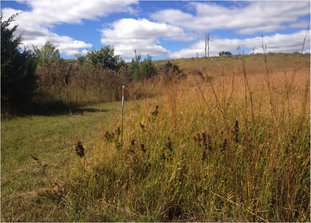
These are two different experimental plots within the large field experiment at Konza Prairie Biological Station. The one with lots of trees is an unburned plot, the one with lots of grass is a burned plot.

Lydia and Christine read about how grassland scientists have been doing research to learn more about what happens when fire is stopped and excess nutrients are added. These changes reduce biodiversity and affect which species of plants can grow in the prairie. However, Lydia and Christine noticed that the research had been mostly focused on what happens aboveground.  Lydia and Christine had a hunch that the aboveground communities were not the only things changing. They thought that belowground components would be changed by fire and fertilizer too. They turned their focus to microbes in the soil, because they also use nutrients. In addition, they thought these microorganism would be affected by the changes in aboveground plant biodiversity. 

To see if this was true, they used data that they and other scientists collected at Konza Prairie Biological Station from a large field experiment. The experiment was set up in 1986 and the treatments were applied at the field site every year until 2017! Lydia and Christine focused on the fertilizer (nitrogen) addition and prescribed burning treatments to answer their questions. The nitrogen treatment had eight plots where nitrogen had been added and eight with no nitrogen as a control. Similarly, the prescribed burn treatment was applied to eight plots, while eight plots had no burning as a control. These two treatments were also crossed with each other, meaning that some plots were burned and nitrogen was added.

Lydia and Christine expected the types of microbes in the soil to change in response to the nitrogen and burning treatments because of the different aboveground plant communities and difference in soil nutrients. Soil microbial communities can change in multiple ways. First, the number of unique species can increase or decrease, measured as richness. The other way is how many individuals of each species there are in the community, measured as evenness. Taken together, richness and evenness give a measure of diversity, which can be summarized using the Shannon-Wiener index. The value will get bigger if either richness or evenness increases because it incorporates both. For example, a community with five species that has equal abundance of each will have a larger Shannon-Wiener index than a community with five species where one species has a lot more individuals than the other four.  

Featured Scientists: Lydia Zeglin and Christine Carson from the Konza Prairie Biological Station. Written By: Jaide Allenbrand

Flesch–Kincaid Reading Grade Level = 10.4

Mangroves on the move

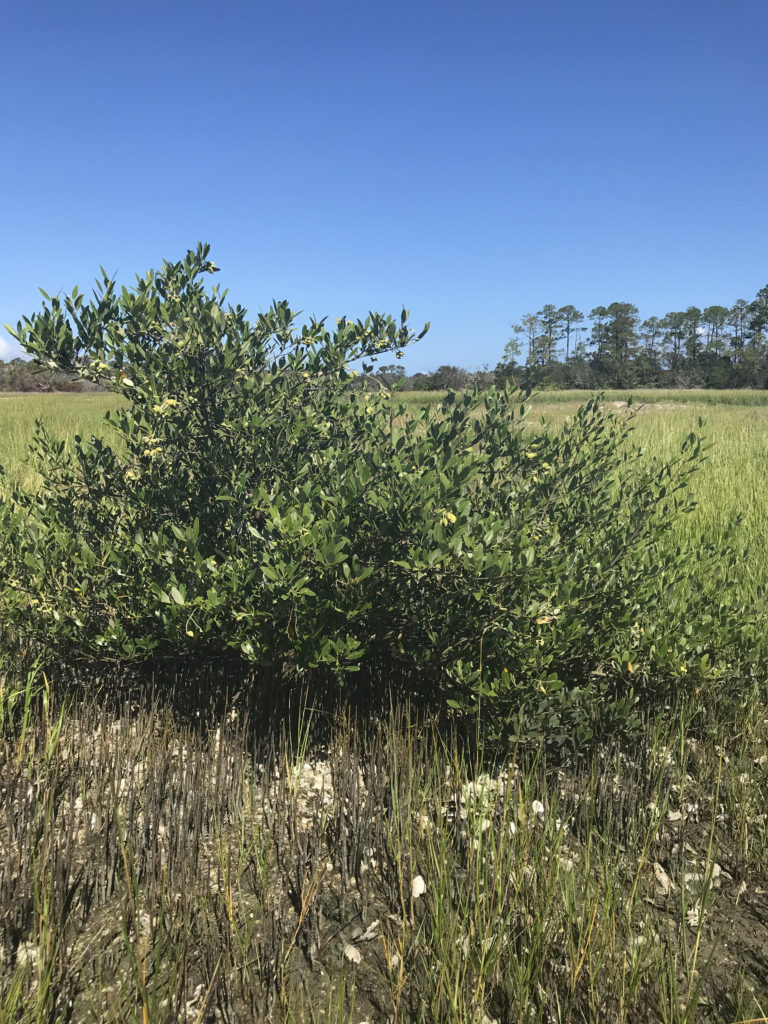
mangrove in marsh
A black mangrove growing in the saltmarshes of northern Florida.

The activities are as follows:

All plants need nutrients to grow. Sometimes one nutrient is less abundant than others in a particular environment. This is called a limiting nutrient. If the limiting nutrient is given to the plant, the plant will grow in response. For example, if there is plenty of phosphorus, but very little nitrogen, then adding more phosphorus won’t help plants grow, but adding more nitrogen will. 

Saltmarshes are a common habitat along marine coastlines in North America. Saltmarsh plants get nutrients from both the soil and the seawater that comes in with the tides. In these areas, fertilizers from farms and lawns often end up in the water, adding lots of nutrients that become available to coastal plants. These fertilizers may contain the limiting nutrients that plants need, helping them grow faster and more densely.

One day while Candy, a scientist, was out in a saltmarsh in northern Florida, she noticed something that shouldn’t be there. There was a plant out of place. Normally, saltmarshes in that area are full of grasses and other small plants—there are no trees or woody shrubs. But the plant that Candy noticed was a mangrove. Mangroves are woody plants that can live in saltwater, but are usually only found in tropical places that are very warm. Candy thought the closest mangrove was miles away in the warmer southern parts of Florida. What was this little shrub doing so far from home? The more that Candy and her colleague Emily looked, the more mangroves they found in places they had not been before.

Candy and Emily wondered why mangroves were starting to pop up in northern Florida. Previous research has shown nitrogen and phosphorus are often the limiting nutrients in saltmarshes. They thought that fertilizers being washed into the ocean have made nitrogen or phosphorus available for mangroves, allowing them to grow in that area for the first time. So, Candy and Emily designed an experiment to figure out which nutrient was limiting for saltmarsh plants. 

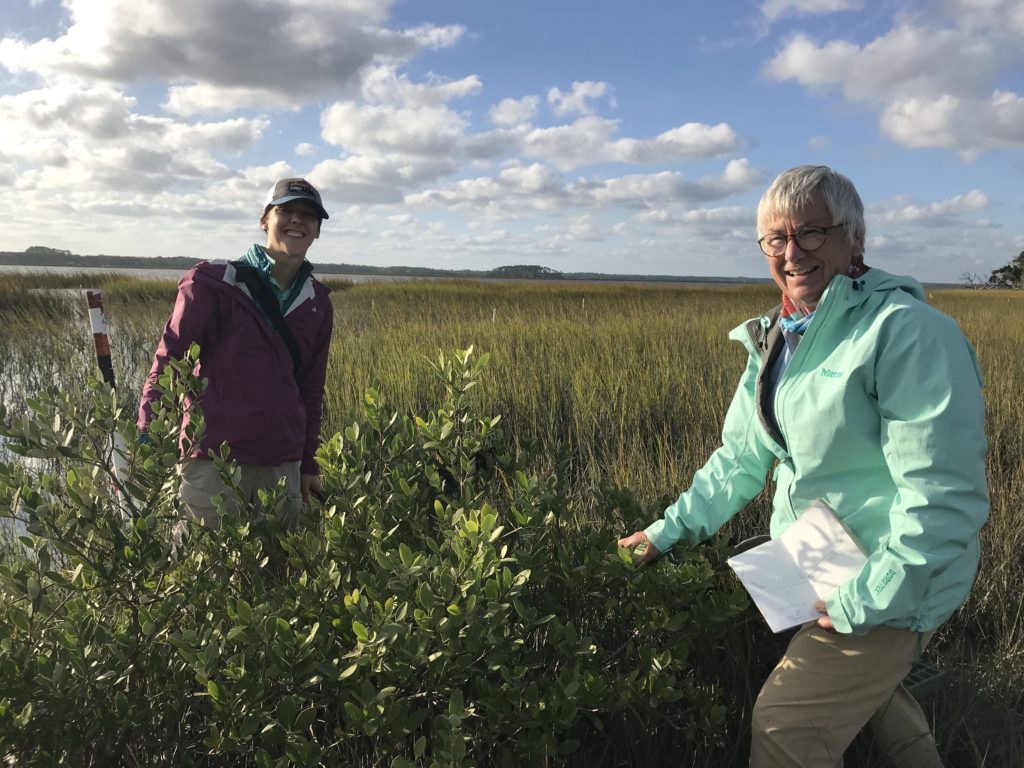
mangrove saltmarsh researchers
Candy (right) and Emily (left) measure the height of a black mangrove growing in the saltmarsh.

For their study, Candy and Emily chose to focus on black mangroves and saltwort plants. These two species are often found growing together, and mangroves have to compete with saltwort. Candy and Emily found a saltmarsh near St. Augustine, Florida, in which they could set up an experiment. They set up 12 plots that contained both black mangrove and saltwort. Each plot had one mangrove plant and multiple smaller saltwort plants. That way, when they added nutrients to the plots they could compare the responses of mangroves with the responses of saltwort. 

To each of the 12 plots they applied one of three conditions: control (no extra nutrients), nitrogen added, and phosphorus added. They dug two holes in each plot and added the nutrients using fertilizers, which slowly released into the nearby soil. In the case of control plots, they dug the holes but put the soil back without adding fertilizer.

Candy and Emily repeated this process every winter for four years. At the end of four years, they measured plant height and percent cover for the two species. Percent (%) cover is a way of measuring how densely a plant grows, and is the percentage of a given area that a plant takes up when viewed from above. Candy and Emily measured percent cover in 1×1 meter plots. The cover for each species could vary from 0 to 100%.

Featured scientists: Candy Feller from the Smithsonian Environmental Research Center and Emily Dangremond from Roosevelt University

Flesch–Kincaid Reading Grade Level = 8.3

Corals in a strange place

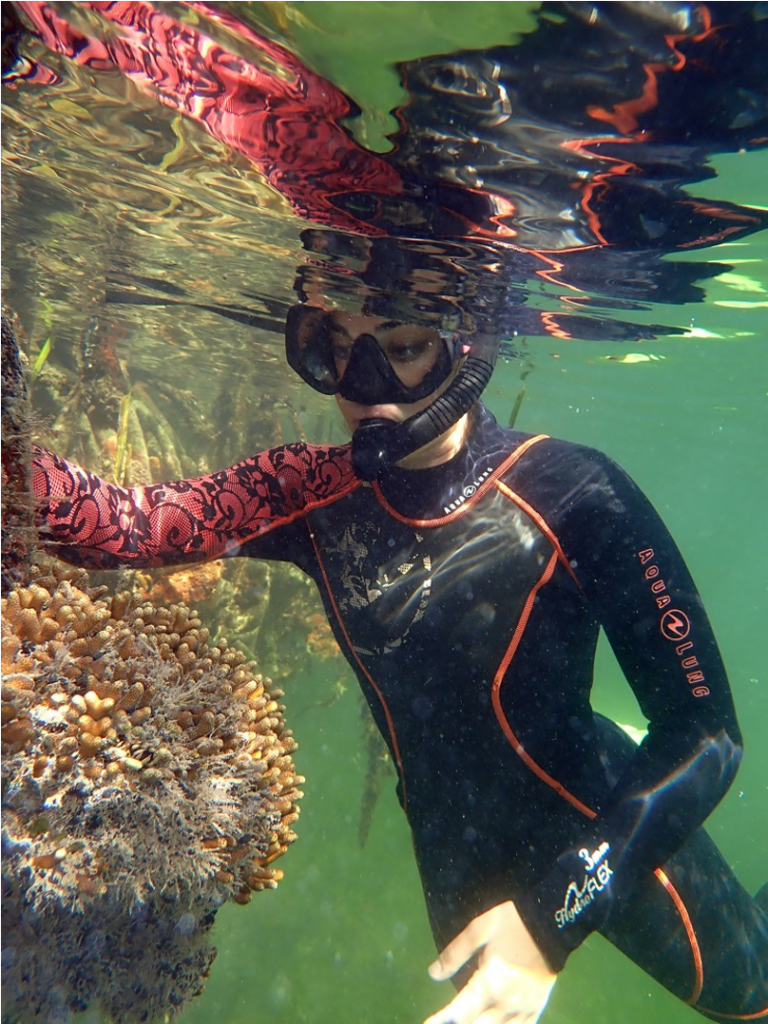
Marine Biologist, Karina, snorkeling in the mangroves. Photo by John Finnerty.

The activities are as follows:

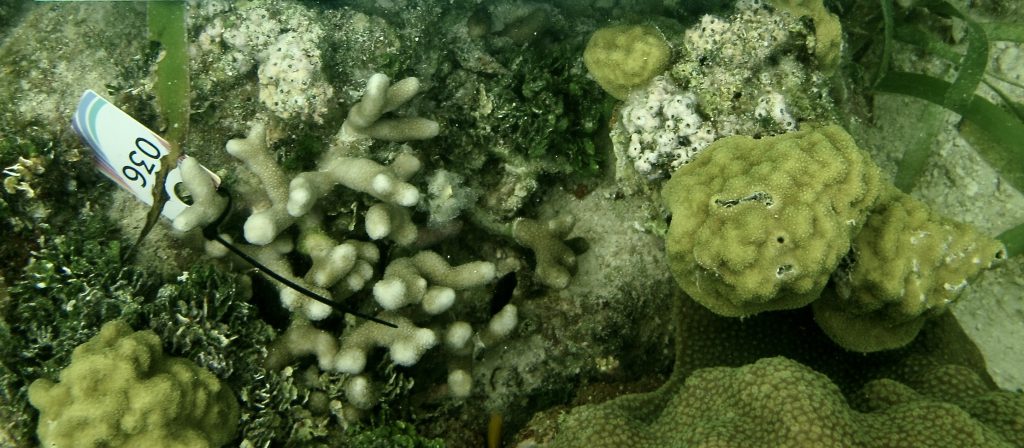
When you imagine a coral, you likely picture it living on a coral reef, bathed in sunlight, surrounded by crystal clear waters teeming with colorful fishes. But corals can actually live in a range of habitats, even habitats that are sometimes murky and much darker!

As marine biologists, Karina and John often snorkel around the mangroves in Belize, where they do their research. Mangroves are trees that have roots able to grow in saltwater. By capturing mud and sediment, these underwater roots build habitat for marine life. While Karina and John were documenting the different marine life that can grow on underwater roots, they noticed something shocking. The same corals that live on coral reefs were growing in the mangrove forests too! This surprised Karina and John because coral reefs and mangrove forests are very different habitats. Coral reefs have clear water and bright light, while mangrove forests are darker with murky water that has a lot of nutrients. How can corals live in such different places?

Karina and John started to wonder if the corals that live in the mangroves look different than the corals on the reefs. Sometimes animals can look different based on where they live. These differences may be adaptations that help them live in different environments. Karina and John measured differences between two different coral species that were found in both habitat types. The two species they used are the mounding mustard hill coral and the branching thin finger coral.   

Featured scientists: Karina Scavo Lord and John Finnerty from Boston University

Flesch–Kincaid Reading Grade Level = 8.9

Data Nuggets researchers lead collaborative study examining representation in STEM curriculum

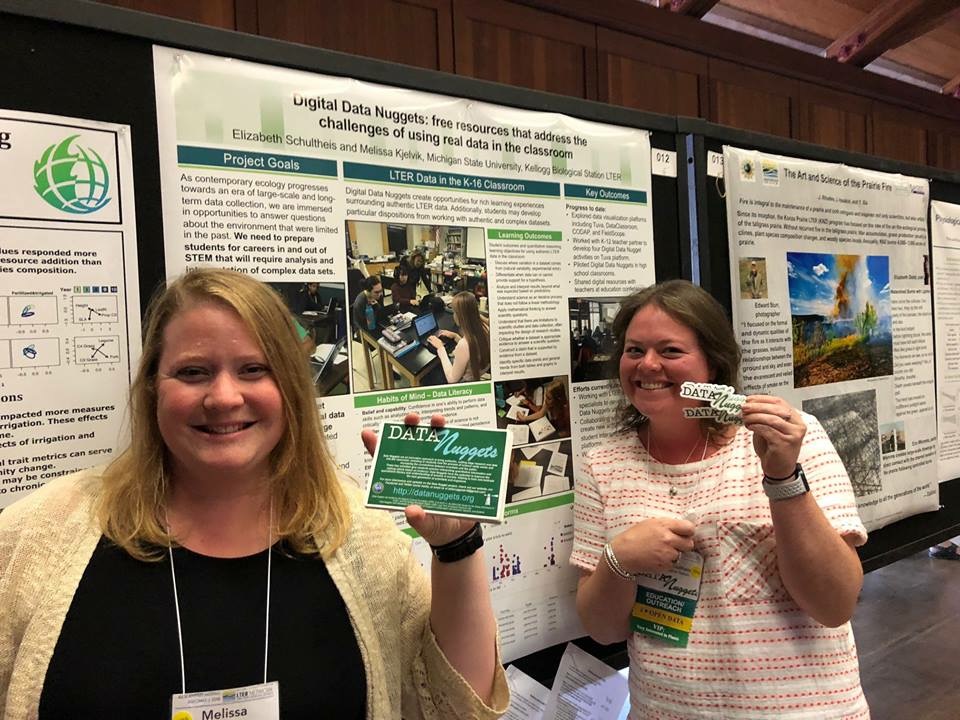
Melissa and Liz presenting Data Nuggets.
Melissa (left) and Liz (right) presenting Data Nuggets at the LTER All Scientists Meeting.

When you were a child, what was your image of a scientist? Could you imagine yourself in those shoes?

A new, National Science Foundation-funded study led by Michigan State University researchers and others aims to better understand how science instruction that contains diverse scientist role models affects student attitudes about science, technology, engineering and mathematics—STEM—courses and careers. 

Data Nuggets, a project that has created free STEM classroom activities since 2011, is integral to the new study. Data Nuggets was founded by postdoctoral researchers Elizabeth Schultheis and Melissa Kjelvik, both of whom conducted doctoral research at the W.K. Kellogg Biological Station. The Data Nuggets activities were co-developed through collaborations between scientists and K-16 educators.

MSU ecologist Marjorie Weber will lead the study. Other members of the research team include Schultheis and Kjelvik, and Cissy Ballen and Ash Zemenick of Auburn University.

Post originally from Kellogg Biological Station.

Limit by limit: Nutrients control algal growth in Arctic streams

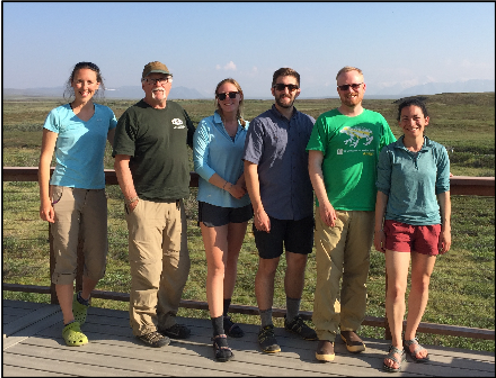
The Arctic Stream Team. Frances, Breck, Abby, Alex, Jay, and Arial at Toolik Field Station in 2019. 

The activities are as follows:

You rely on the nutrients from the foods you eat to grow and thrive. Other organisms, like microbes, do as well! Aquatic algae, a type of microbe that live in the water, need to take in nutrients from their surroundings for growth. Two important nutrients for algal growth are nitrogen (N) and phosphorous (P).

Sometimes the environment does not have all the nutrients that aquatic algae need to grow. When one nutrient is less available compared to others, algae can become nutrient limited. Research on nutrient limitation started with Justus Liebig, a 19th century scientist who proposed the “law of the minimum.” The law states that the nutrient available in the lowest amount relative to demand will limit overall growth and production. This means that growth is not controlled by all the nutrients, but by the scarcest one (the “limiting factor”). When more than one nutrient limits growth, algae are considered co-limited. This just means that a combination of two nutrients are needed for algae to grow. Knowing what nutrients are limiting growth helps scientists understand how an ecosystem is working.  

From other research we know that many ecosystems, including those in the Alaskan Arctic, are phosphorus-limited. Scientists figured this out because they found if they added phosphorus, then algae growth increased. However, climate change could change this. As the Arctic warms, ecosystems on land might start to release nutrients in higher amounts or new proportions into the water. These extra nutrients will likely cause increases in algae growth in streams and ponds, which in turn could change food webs and nutrient cycling. It is therefore important to understand which nutrients are currently limiting algae growth before climate change changes things even more. This starts with tests to see how Arctic algae grow in response to changes in N, P, and N and P in the water.  

A team of scientists got to work on this question! Arial, Jay, Frances, Alex, Breck, and Abby are all interested in understanding how climate change may alter nutrient limitations in Arctic streams. Each team member has a unique role in the larger research project. For example, undergraduate researcher Abby spent her 2019 summer at Toolik Field Station in Northern Alaska as part of a research opportunity. She explored nutrient limitation in one particular lake, called Lake I8. 

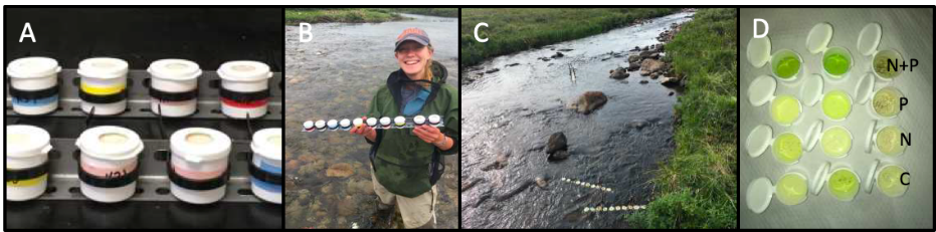
Abby used small cups that placed into the streams that fed into Lake I8. These cups were filled with agar gel, a material used in labs to grow microbes. Each cup contained different nutrient treatments. Abby used four different treatments in her cups: (1) a control (agar only), (2) agar + nitrogen, (3) agar + phosphorus, and (4) agar + nitrogen + phosphorus. On the top of each cup, she placed a glass disk to provide a surface for the algae to grow.

A. Cups before going into the stream. B. Abby putting out her cup treatments into an Arctic stream. C. Cups incubating under water in an Arctic stream. D. Analyzing Chlorophyll a extracted from the cups. 

Abby put 5 replicate cups for each treatment at both the Inlet and Outlet streams on the I8 Lake. She left them underwater for 4 weeks. She brought the cups back to the lab to measure the algae that grew on each glass disk. Abby measured how much algae grew on each disk by measuring the amount of Chlorophyll a, the green pigment that helps plants photosynthesize. The more pigment, the more the algae is growing. Abby compared the data from the control to each of the other treatments. When there is more growth in a treatment compared to the control, that means a particular nutrient was limiting at that location. Abby expected that the streams would be limited by the amount of phosphorus, but not the amount of nitrogen. She predicted algae would grow more when they are given additional phosphorus compared to the control treatment.

Featured scientists: Abigail Rec from Gettysburg College; Frances Iannucci, Alex Medvedeff, and Breck Bowden from University of Vermont; Arial Shogren and Jay Zarnetske from Michigan State University

Flesch–Kincaid Reading Grade Level = 8.6

Working to reduce the plastics problem

stretching the raw, preformed polymers
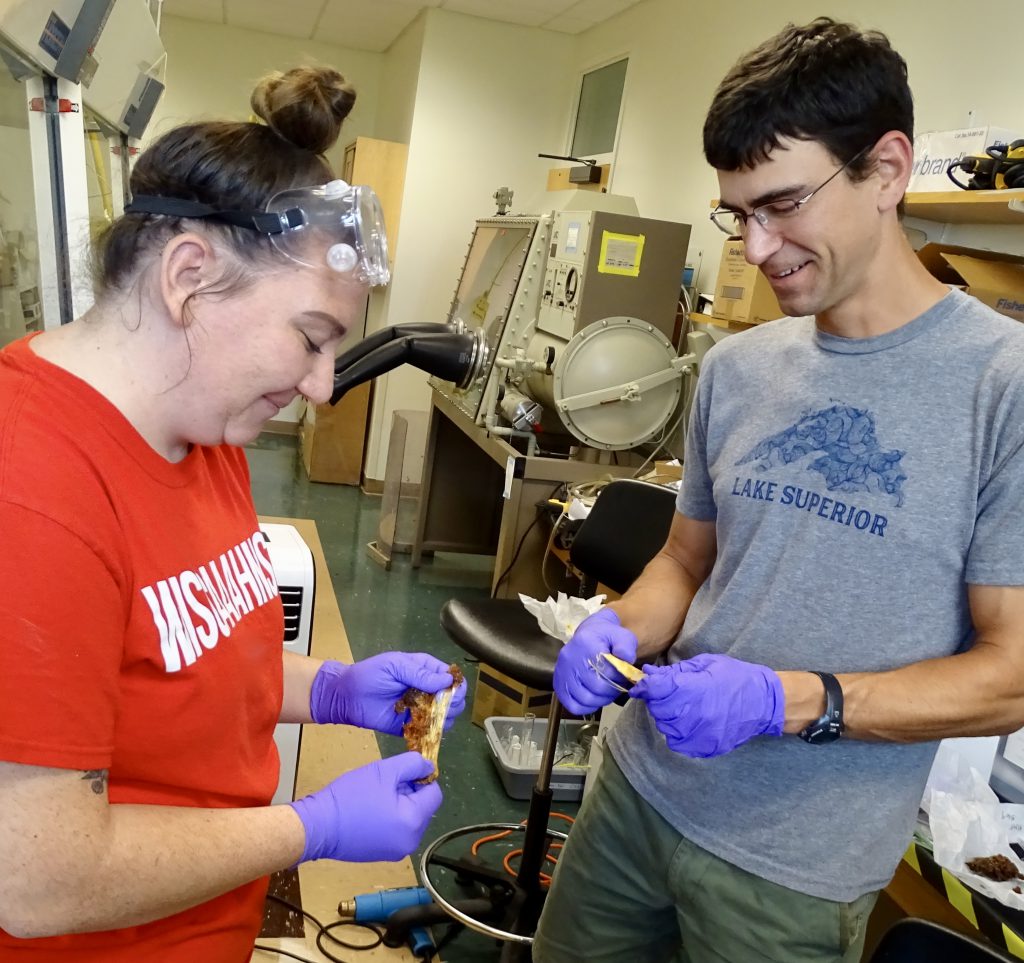
Nick (right) and one of his students (left) stretching the raw, preformed polymers.

The activities are as follows:

Plastics are materials that can be shaped easily and are used for many functions. This has made them extremely popular across the world. Thousands of products are made using plastic, including parts of cell phones, food wrappers from your lunch, and even the stitches you may need after an injury. In fact, if you look around right now, you can probably spot at least ten items made of plastic!

Once a plastic is made, it tends to stick around. Synthetic plastics, made by humans from petroleum, cannot be broken down by nature’s decomposers – bacteria and fungi. This means they impact the environment for many, many years. Some types can take thousands of years or longer to break down! 

Nick is a chemist concerned with the negative impacts caused by plastics. He knows that in order to reduce the amount of synthetic plastics in the environment, we need an alternative. And, this alternative needs to be just as good as the synthetic plastic it is replacing. Nick and his undergraduate students at Northland College are testing new ways to make plastics that are biodegradable, meaning they can be decomposed naturally and won’t last as long in the environment. His research focuses on stretchy plastics, called elastomers.Elastomers are what make up rubber bands, tires, hoses, non-latex gloves, and many more items we use every day. 

To try to solve the problem of making a biodegradable elastomer that has all the qualities of a synthetic one, Nick and his students got to work. First, they had to consider the chemical structure of plastics. Plastics are made of polymers. “Poly” means “many” and “mer” means “parts”. This means that plastics are made of long chain molecules with many repeating parts. These repeating parts are called monomers. Different monomers can be used to make different types of plastic.

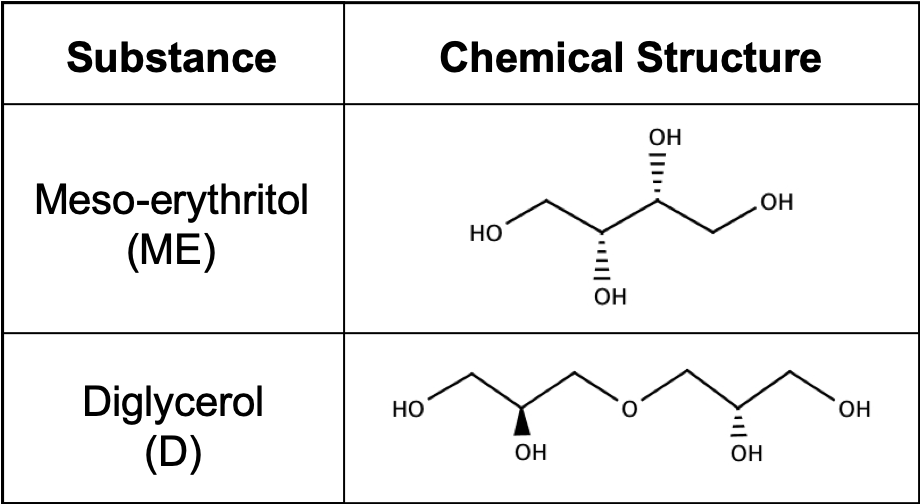
Nick chose to test two biodegradable monomers – diglycerol and meso-erythritol. Diglycerol is cheap and easy to buy. However, it might be too soft when used on its own. Meso-erythritol is more expensive, but more rigid. They wanted to use diglycerol and meso-erythritol because the chemical structures have the potential to create something that is not too rigid and not too flexible.

Nick and his students designed an experiment in which they tested elastomers made from each of the monomers (diglycerol and meso-erythritol) alone, as well as elastomers made using both types of monomers. They made elastomers with the following percentage ratios of diglycerol over meso-erythritol: 100/0, 75/25, 50/50, 25/75, 0/100. The team was hoping to find the “sweet spot” between a product that is too stiff, and one that is not stiff enough to be useful in elastic materials. Once they finished making their elastomers, they prepared the stretch tests. 

To start a stretch test, the team had to stamp out a piece of material from each elastomer, creating samples with the same size, shape, and thickness. They also cut pieces from rubber bands made of synthetic plastics to compare as a control. Next, they tested the elastomers using a machine that measures how much force is applied (stress) as a material is stretched (strain), both important measures of elasticity. The stress, or force per unit of area, is measured in megapascals (MPa) while the strain, or amount of stretch, is measured as a percent of the original length. 

Featured scientist: Nick Robertson from Northland College. Written by: Theresa Paulsen from Ashland High School, Wisconsin

Flesch–Kincaid Reading Grade Level = 9.6

For additional information on the plastic problem, and Nick’s research, check out the following resources:

Where to find the hungry, hungry herbivores

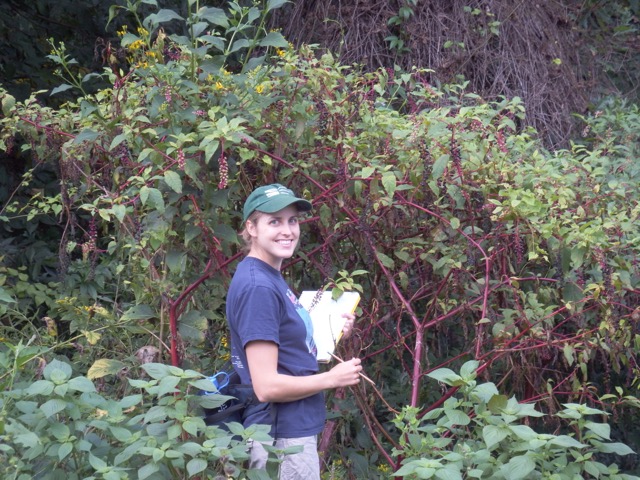
Carina and some pokeweed plants in Tennessee.

The activities are as follows:

Éste Data Nugget también está disponible en Español:

When travelling to warm, tropical places you are exposed to greater risk of diseases like malaria, yellow fever, or dengue fever. The same pattern of risk is true for other species besides humans. For example, scientists have noticed that crops seem to have more problems with pests if they grow at lower latitudes (closer to the equator). Locations that are at lower latitudes have warm climates. We don’t know exactly why there are more pests in warmer places, but it could be because pests have a hard time surviving very cold winters. 

Carina is interested in figuring out more about this pest-y problem. She first got excited about plants in school, when she learned that they use photosynthesis to make their own food out of light, air, and water. She thought it was fascinating that plants have evolved so many different strategies to survive. Even though they don’t have brains, plants do have adaptations that help them compete for light and mate in many different habitats. Carina continues to learn more every day, and especially enjoys researching how plants defend themselves against herbivores, or animals that eat plants. Herbivores pose a challenge because plants can’t run away or hide! 

Carina studies ways wild plants can defend themselves against herbivores. What she learns in wild plants could give us ideas of how to help crops defend against pests too. Scientists aren’t sure why crops have more pest problems in warmer places, but it would help to understand if wild plants also have the same pattern. 

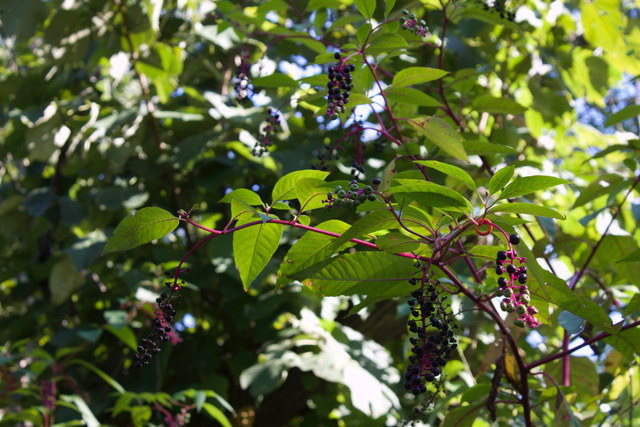
Pokeweed (Phytolacca americana) is a common wild plant that grows all over the eastern US. Pokeweed has beautiful pink stems and dark purple berries. In fact, the Declaration of Independence was written with ink made from pokeweed berry juice!

So Carina decided to travel all across the eastern United States to measure herbivory on pokeweed, a common wild plant there. Carina drove a lot for this project! In one summer, she visited ten patches of pokeweed spread out between Michigan and Florida. Carina thought that the pokeweed found at lower latitudes (Florida, 27° N) would have higher herbivory than pokeweed at northern latitudes (Michigan, 42° N) because pests may not be able to survive as well in places with harsh winters. 

At each of the ten sites, she marked five very young leaves on 30 to 40 plants. That equals over 1,500 leaves! She then came back six weeks later to measure how much the leaves were eaten as they grew into large, mature leaves. When leaves are young, they are more tender and can be more easily eaten by herbivores (that’s why we eat “baby spinach” salad). To measure herbivory she compared the area that was eaten to the total area of the leaf, and calculated the percent of the leaf area eaten by caterpillars, the main herbivores on pokeweed. She then averaged the percent eaten on leaves for each plant. Some plants died in those 6 weeks, so the sample size at the end of the study ranged from 4 to 37 depending on the site.

Featured scientist: Carina Baskett from Michigan State University

Flesch–Kincaid Reading Grade Level = 9.4

There is one scientific paper associated with the research in this Data Nugget. The citation and link to the paper is below.

Baskett, C.A. and D.W. Schemske (2018) Latitudinal patterns of herbivore pressure in a temperate herb support the biotic interactions hypothesis. Ecology Letters 21(4):578-587.