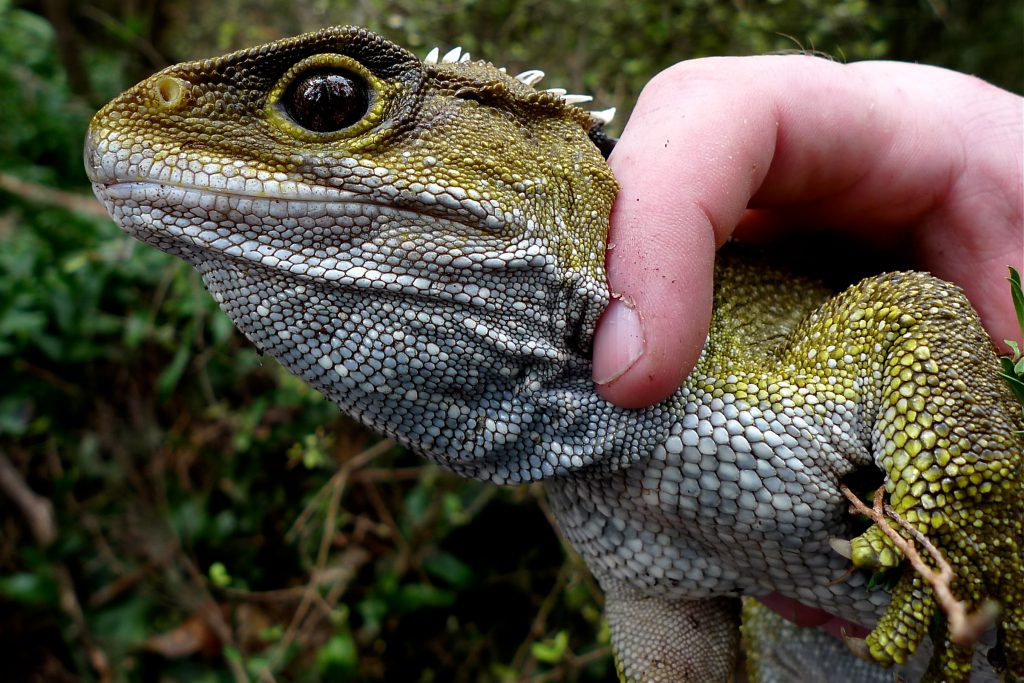
An adult male tuatara. Photo by Scott Jarvie.
The activities are as follows:
- Teacher Guide
- Student activity, Graph Type A, Level 3
- Student activity, Graph Type B, Level 3
- Student activity, Graph Type C, Level 3
- Grading Rubric
- Digital Data Nugget on DataClassroom
Tuatara are a unique species of reptile found only in New Zealand. Tuatara look like lizards but they are actually in their own reptile group. Tuatara are the only species remaining on the planet from this lineage, one that dates to the time of the dinosaurs! Tuatara are similar to tortoises in that they are extremely long-lived and can sometimes live over 100 years. Tuatara start reproducing when they are about 15–20 years old and they breed infrequently.
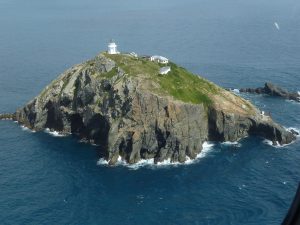
North Brother Island, one of the small New Zealand islands where tuatara are still found today. Photo by Jo Monks.
The sex of tuatara is not determined by sex chromosomes (X or Y) as in humans. Instead, the temperature of the nest during egg development is the only factor that determines the sex of tuatara embryos. If the egg develops with a low temperature in the nest it will be female, but if it develops with a high temperature it will be male. This process happens in many other species, too, including some turtles, crocodiles, lizards, and fish. However, most species are the opposite of tuatara and produce females at the warmest temperatures.
Today, tuatara face many challenges. Humans introduced new predators to the large North and South Islands of New Zealand. Tuatara used to live on these main islands, but predators drove the island populations to extinction. Today, the tuatara survive only on smaller offshore islands where they can escape predation. Because many of these islands are small, tuatara can have low population numbers that are very vulnerable to a variety of risk factors. One of the current challenges faced by these populations is climate change. Similar to the rest of the world, New Zealand is experiencing higher and higher temperatures as a result of climate change, and the warm temperatures may impact tuatara reproduction.
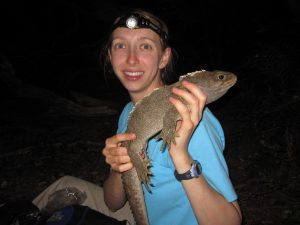
Kristine collecting data on a tuatara in the field. Photo by Sue Keall.
North Brother Island has a small population of tuatara (350–500 individuals) that has been studied for decades. Every single tuatara has been marked with a microchip (like the ones used on pet dogs and cats), which allows scientists to identify and measure the same individuals repeatedly across several years. In the 1990s, a group of scientists studying the tuatara on this island noticed that there were more males than females (60% males). The scientists started collecting data on the number of males and females so they could track whether the sex ratio, or the ratio of males and females in the population, became more balanced or became even more male-biased over time. The sex ratio is important because when there are fewer females in a population, there are fewer individuals that lay eggs and produce future offspring. Generally, a population that is highly male-biased will have lower reproduction rates than a population that is more balanced or is female-biased.
The fact that tuatara are long-lived and breed infrequently meant that the scientists needed to follow the sex ratio for many years to be sure they were capturing a true shift in the sexes over time, not just a short-term variation. In 2012, Kristine and her colleagues decided to use these long-term data to see if the increasing temperatures from climate change were associated with the changing sex ratio. They predicted that there would be a greater proportion of males in the population over time. This would be reflected in an unbalanced sex ratio that is moving further and further away from 50% males and 50% females and toward a male-biased population.
Featured scientists: Kristine Grayson from University of Richmond, Nicola Mitchell from University of Western Australia, and Nicola Nelson from Victoria University of Wellington
Flesch–Kincaid Reading Grade Level = 11.9
Additional teacher resources related to this Data Nugget:
- Video Recording from Headwaters Institute: Lunch with a scientist – Meet Dr. Kristine Grayson!
- Want to learn more about tuatara or introduce students to this species before beginning the Data Nugget? Check out this video by “It’s ok to be smart”.
- There are two publications associated with the research in this activity:
- Grayson, Kristine L., Nicola J. Mitchell, Joanne M. Monks, Susan N. Keall, Joanna N. Wilson, and Nicola J. Nelson (2014). Sex Ratio Bias and Extinction Risk in an Isolated Population of Tuatara (Sphenodon punctatus). PLoS ONE 9(4): e94214.
- Grayson, Kristine L., Nicola J. Mitchell, and Nicola J. Nelson (2014). A Threat to New Zealand’s Tuatara Heats Up. American Scientist 102: 350-357.
- For a popular science article about tuatara research, written for students, check out Science News for Student’s article “When a species can’t stand the heat: Global warming could leave New Zealand’s tuatara dangerously short of females” (PDF for printing, Word Search!)
- Students can access the National Institute of Water and Atmospheric Research (NIWA) New Zealand weather station data here.
 About Kristine: Kristine L. Grayson is an Associate Professor in the Biology Department at University of Richmond, where she teaches Intro Ecology/Evolution, Field Ecology, Ecophysiology, and Data Visualization. She is an HHMI BioInteractive Ambassador and facilitator with the Quantitative Undergraduate Biology Education and Synthesis (QUBES) project, where you can find additional teaching resources she has authored. Kristine runs an undergraduate research lab studying invasive insects, salamanders, and aquatic macroinvertebrates. Her work on tuatara was conducted during a postdoc at Victoria University of Wellington funded by an NSF International Research Fellowship. One of her claims to fame is capturing the state record holding snapping turtle for North Carolina – 52 pounds! To read more about Kristine and her interest in science from a young age, check out this article.
 About Carrie: I have been interested in animal behavior and behavioral ecology since my second year in college at the University of Tennessee. I am primarily interested in how variation in ecology and environment affect communication and signaling in birds. I have also studied various types of memory and am interested in how animals learn and use information depending on how their environment varies over space and time. I am currently working on my PhD in Ecology, Evolution, and Conservation Biology at the University of Nevada Reno and once I finish I hope to become a professor at a university so that I can continue to conduct research and teach students about animal behavior. In my spare time I love hiking with my friends and dogs, and watching comedies!


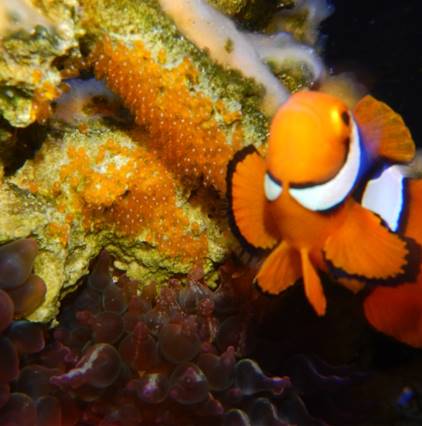
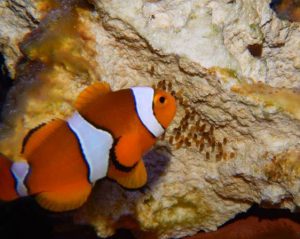
 About Tina: I first became interested in science catching frogs and snakes in my backyard in Ithaca, NY. This inspired me to major in Biology at Cornell University, located in my hometown. As an undergraduate, I studied male competition and sperm allocation in the local spotted salamander, Ambystoma maculatum. After graduating, I joined the Peace Corps and spent 2 years in Morocco teaching environmental education and 6 months in Liberia teaching high school chemistry. As a PhD student in the Buston Lab, I study how parents negotiate over parental care in my study system the clownfish, Amphiprion percula, otherwise known as Nemo.
  The activities are as follows:
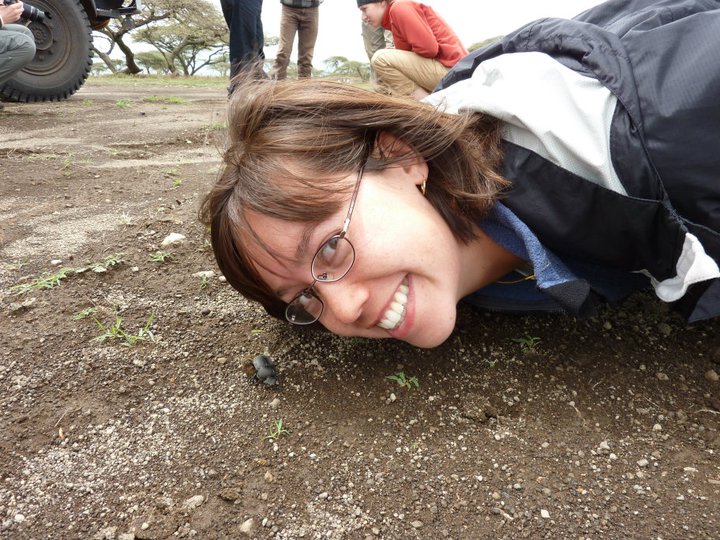
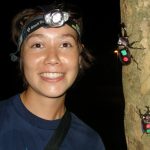 About Erin: I am fascinated by morphological diversity, and my research aims to understand the selective pressures that drive (and constrain) the evolution of animal form. Competition for mates is a particularly strong evolutionary force, and my research focuses on how sexual selection has contributed to the elaborate and diverse morphologies found throughout the animal kingdom. Using horned beetles as a model system, I am interested in how male-male competition has driven the evolution of diverse weapon morphologies, and how sexual selection has shaped the evolution of physical performance capabilities. I am first and foremost a behavioral ecologist, but my research integrates many disciplines, including functional morphology, physiology, biomechanics, ecology, and evolution.