The science of stamen loss

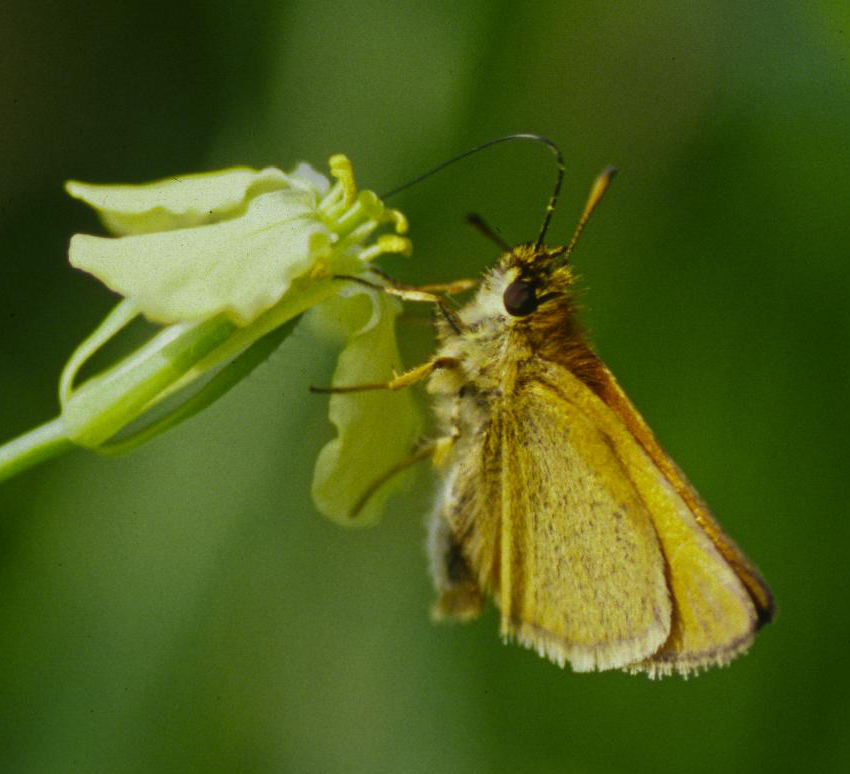
A pollinator visiting a mustard flower, drinking nectar and picking up pollen from anthers.

The activities are as follows:

Plants and animals have adaptations, or traits that help them survive and pass on more of their genes to the next generation. Flowers are a key adaptation for plants because they help the attract pollinators and reproduce.

Flowers come in many different shapes, sizes, colors, and forms. While flowers as a whole are an adaptation, traits within flowers are often adaptations themselves. For example, different flower colors attract different types of animals to the plant. Some flowers make nectar that gives animals a food reward for visiting. Other plants have small flowers with no petals so that pollen can be easily picked up and travel by wind.

Many of the animals that visit the plant serve as pollinators. Pollinators help plants reproduce by bringing reproductive parts together. Pollination happens when pollen from the stamen reaches the stigma. This is needed for seeds to form. By moving pollen, pollinators help plants make more seeds. More seeds lead to more plants in the next generation. Small differences in flower traits can change which plant is the most successful at reproducing and setting seed.

Jeff is a scientist studying a very particular flower shape seen in plants of the mustard family. Most plants in this family have flowers with 4 long stamens and 2 short stamens. No other plants have this shape, and no one knows why! The short stamens are a particular mystery.

Jeff wanted to see why mustards might have these short stamens. He thought that short stamens are an adaptation because they make it harder for pollinators to reach the pollen, so that more pollen would be left over for later pollinators. This might be beneficial because the first pollinator visiting the flower wouldn’t be able to take all the pollen, leaving none for the following visitors. If his hypothesis was correct, he predicted that short stamens would have less pollen removed with each pollinator visit compared the long stamens.
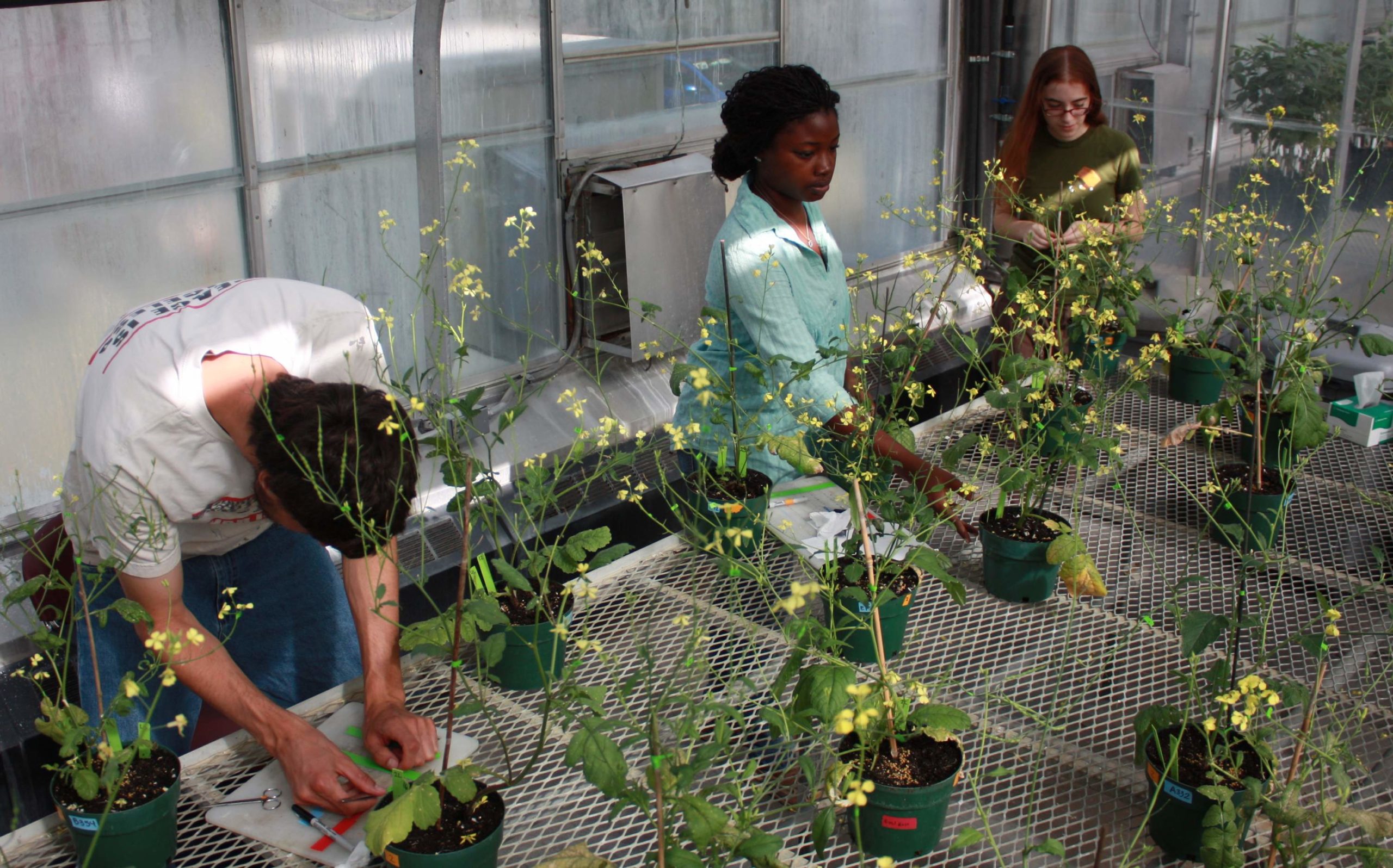
Members of the Conner Lab taking measurements of pollen found on the anthers of short and long stamens.

To collect his data, Jeff and other scientists in his lab needed to measure how much pollen was removed by pollinators on short and long stamens. To do this, they grew mustard plants in the greenhouse and let them flower. This made sure no pollinators could visit the plants before the experiment. Next, they exposed the plants to the three most common pollinators for mustards – bumblebees, small bees, and syrphid flies. To test honeybees, plants were put into flight cages with bees inside. To test small bees and syrphids, plants were put outside. Pollinators chose the flower to visit. After each visit, the lab counted the pollen on the visited flower. They then compared it to the amount of pollen on a flower that was not visited. They used these values to calculate the percent pollen removed. This was repeated for short and long stamens.

Featured scientists: Jeff Conner (he/him) from the W.K. Kellogg Biological Station. Written with Kirsten Salonga, Justice High School, Research Experience for Teachers.

Flesch–Kincaid Reading Grade Level = 7.6

Additional teacher resource related to this Data Nugget:

The data featured in this activity has been published. If you are interested in having students read primary scientific literature, they can complete this Data Nugget and then explore the full study here: 

Getting to the roots of serpentine soils

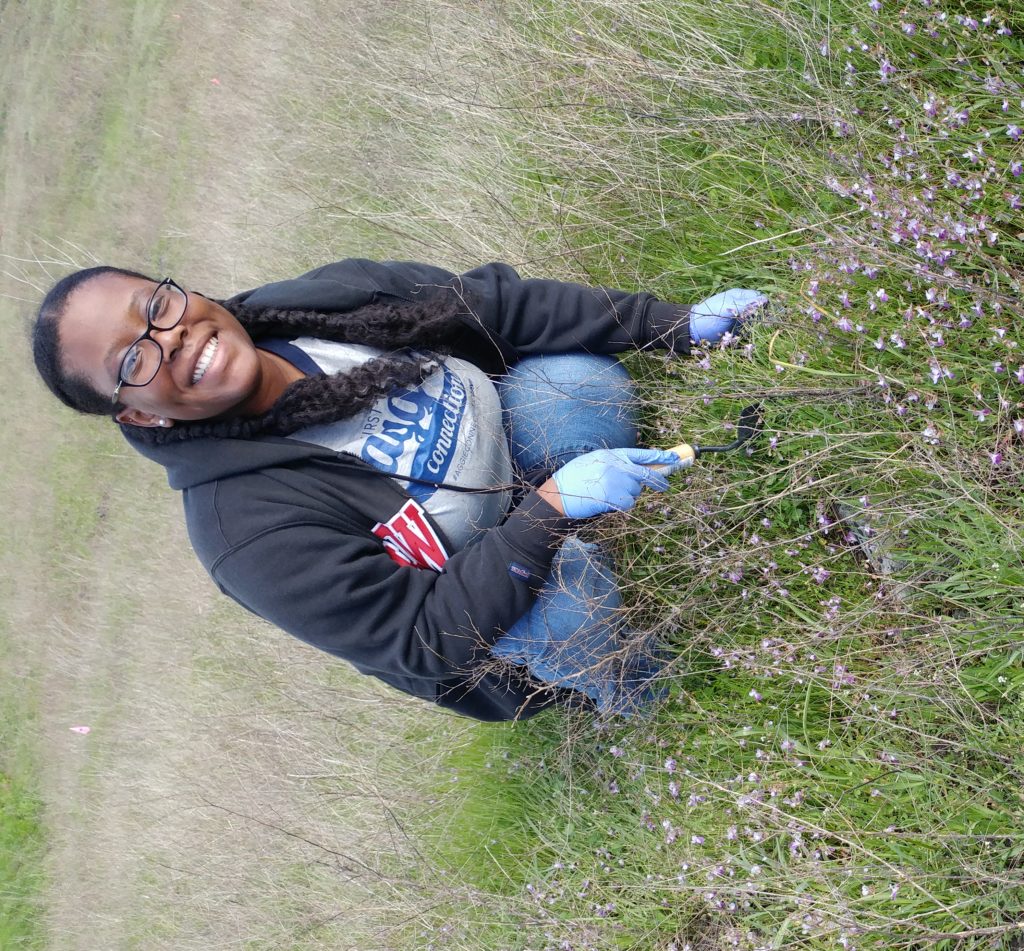
Alexandria in the field observing the plants and soil.

When an organism grows in different environments, some traits change to fit the conditions. For example, if a houseplant is grown in the shade, it might grow to stretch out long and thin to reach as much light as possible. If that same plant were grown in the sun, it would grow thicker stems and more leaves that are not spread as far apart. This response to the environment helps plants grow in the different conditions they find themselves in.

Flexibility is especially important when a plant is living in a harsh environment. One such environment is serpentine soils. These soils are created from the weathering of the California state rock, Serpentinite. Serpentine soils have high amounts of toxic heavy metals, do not hold water well, and have low nutrient levels. Low levels of water and nutrients found in serpentine soils limit plant growth. In addition, a high level of heavy metals in serpentine soils can actually poison the plant with magnesium!

Combined, these qualities make it so that most types of plants are not able to grow on serpentine soils. However, some plant species have traits that help them tolerate these harsh conditions. Species that are able to live in serpentine soils, but can also grow in other environments, are called serpentine-indifferent.

Alexandria has been working with serpentine soils since 2011 when she was first introduced to them during an undergraduate research experience with her ecology professor. Alexandria was especially intrigued by this challenging environment and how organisms are able to thrive in it, even with the harsh characteristics.

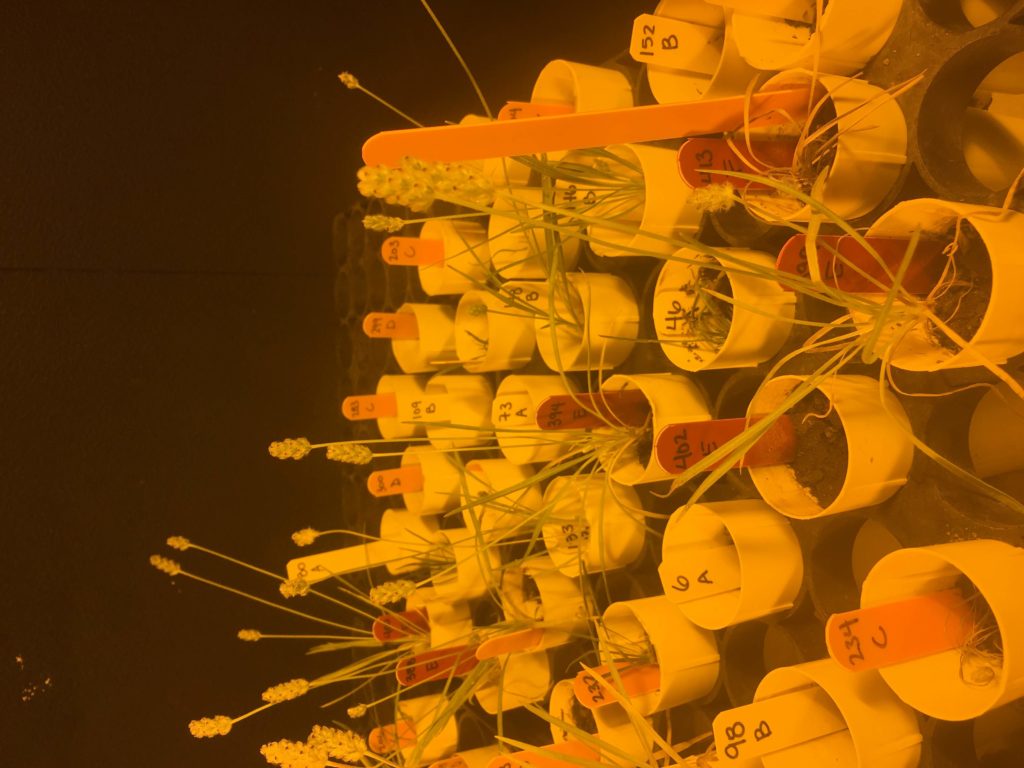
Dot-seed plantain plants in the growth chamber.

To learn more, she started to read articles about previous research on plants that can only grow in serpentine soils. Alexandria learned that these plant species are generally smaller than closely related species. This was interesting, but she still had questions. She noticed the other experiments had compared plant size in different species, not within one species. She thought the next step would be to look at how plants that are the exact same species would respond to serpentine and non-serpentine soil environments. To explore this question, she would need to use serpentine-indifferent plant species because they can grow in serpentine soils and other soils.

Just as a houseplant grows differently in the sun or shade, plants grown in serpentine and non-serpentine soils might change to survive in their environment. Alexandria thought one of these changes could be happening in the roots. She decided to focus on plant roots because of their importance for plant survival and health. Roots are some of the first organs that many plants produce and anchor them to the ground. Throughout a plant’s life, the roots are essential because they bring nutrients to above-ground organs such as leaves. Because serpentine soils have fewer plant nutrients and are drier than non-serpentine soils, Alexandria thought that plants growing in serpentine soils may not invest as much into large root systems. She predicted plants growing in serpentine soils will have smaller roots than plants growing in non-serpentine soils.

To test her ideas, she studied the effects of soil type on a serpentine-indifferent plant species called Dot-seed plantain. She purchased seeds for her experiment from a local commercial seed company. About 5 seeds were planted in serpentine or non-serpentine soils in a growth chamber where growing conditions were kept the same. After the seedlings emerged, the plants were thinned so that there was one plant per pot. The only difference in the environment was the soil type. This allowed Alexandria to attribute any differences in root length to serpentine soils. At the end of her experiment, she pulled the plants out of the soil and measured the root lengths of plants in both treatments.

Featured scientist: Alexandria Igwe (she/her) from University of Miami

Flesch–Kincaid Reading Grade Level = 8.7

Additional resources related to this Data Nugget:

The topics described in this Data Nugget are similar to the published research in the following article:

  • Igwe, A.N. and Vannette, R.L. 2019. Bacterial communities differ between plant species and soil type, and differentially influence seedling establishment on serpentine soils. Plant Soil: 441: 423-437

There is a short video of Alexandria (Allie) sharing her research on serpentine soils.

There have been several news stories and blog posts about this research: