


The activities are as follows:
- Teacher Guide
- Student Activities, Graph Types A-C, Level 3
- Slideshow of Images and Data
- Grading Rubric, CER Tool, and Other Resources
Climate change is affecting our world in many ways. Globally, we are experiencing more droughts and wildfires, shifting seasons, and rising sea levels. Species are responding as well. Some can shift their ranges to follow cooler temperatures. But what about organisms, like fish, that cannot easily move to a new location?
A group of scientists is studying fish in streams in central Oregon to learn more. The H.J. Andrews Experimental Forest, also called the Andrews, is a long-term research site in the Cascade Mountains of central Oregon. Scientists have been collecting data there for decades! The Andrews is an old-growth temperate rainforest with a dense canopy of trees. These trees block the sun’s heat, keeping the understory and streams below cool.
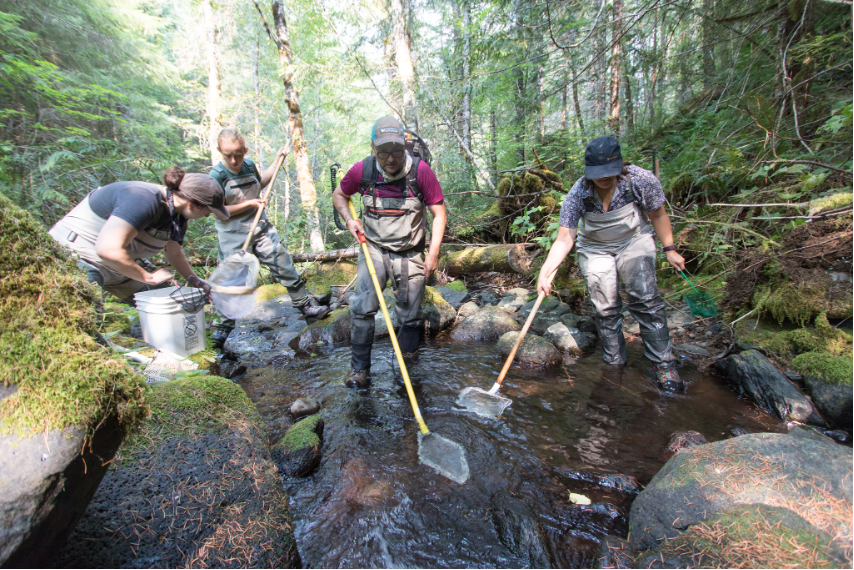
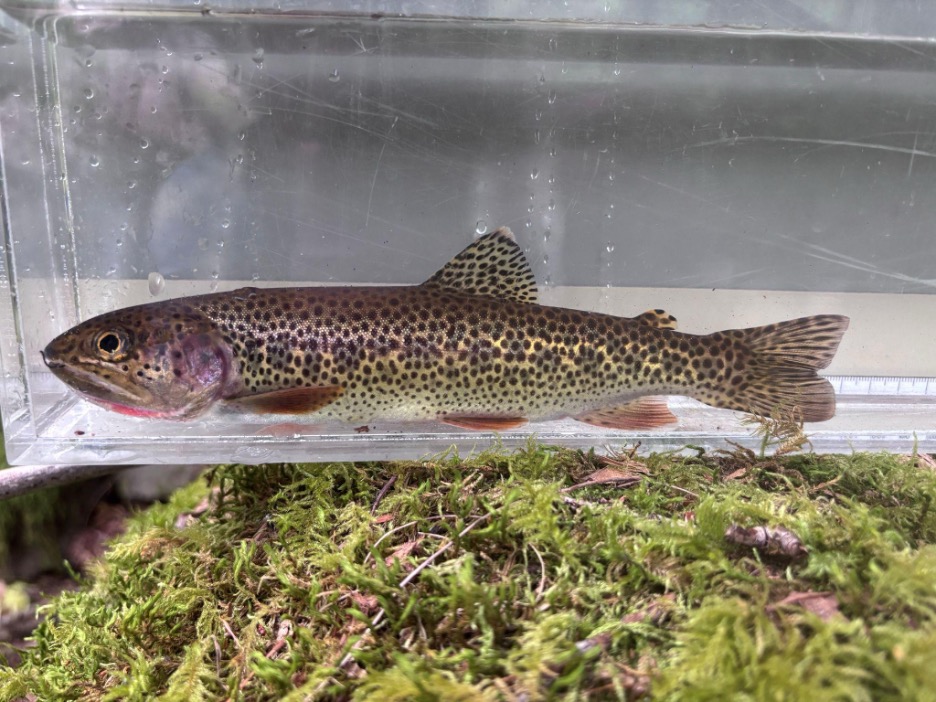
Ivan is a biologist on this team who studies fish in these streams. Originally from southern Chile, he has spent decades studying ecology in both marine and freshwater environments. Ivan first came to Oregon to study how logging affects stream ecosystems. While working at the Andrews, he noticed that air temperatures in the forest were getting warmer over time. He wondered if the stream temperatures were warming too and whether this change might be affecting the fish that live there. He focused on coastal cutthroat trout living in Mack Creek, a stream within the Andrews.
Ivan started his exploration with data from historical surveys. For many years, scientists, staff, and students at the Andrews have been sampling coastal cutthroat trout in the streams. They collect data on their body size and other health measures. Ivan and his team found data on trout fork lengths, or the distance in millimeters (mm) from the tip of the fish’s snout to the center of its tail, dating back to the 1980s. Ivan used these data to calculate the median fork length of trout measured each year. The median is the middle value when all the trout are ordered from smallest to largest.
Ivan also found data on Mack Creek water temperature for the same years as the fish length data. Ivan focused on summer water temperatures because these would be the warmest experienced by the trout each year. He found the highest water temperature recorded each summer day, called daily maximum temperature. He then averaged all the daily maximums for each summer, which gave him one temperature value for each year. This value is the average maximum summer water temperature.
Ivan predicted that he would see stream temperatures go up over time due to climate change impacting the Andrews. He also predicted that trout median fork lengths would be getting shorter over time. He based this idea on the temperature-size rule, a common pattern seen in fish. In warmer temperatures, fish metabolism speeds up, and animals with faster metabolisms often mature at a smaller body size. This would support the idea that climate change was leading to smaller fish in the Andrews.
Featured scientist: Ivan Arismendi from Oregon State University, H.J. Andrews Experimental Forest Long Term Ecological Research Site. Written by Ryan Herlands (he/him) from Springfield Public Schools and Matthew Retterath (he/him) from Fridley Public Schools. This material is based upon work supported by the H.J. Andrews Experimental Forest and Long Term Ecological Research (LTER) program under the NSF grant LTER8 DEB-2025755 and NSF award # 2147138.

Flesch–Kincaid Reading Grade Level = 9.2
Additional Teacher Resources:
You can learn more about the H.J. Andrews experimental forest here. This site is part of the long-term ecological research (LTER) network.