What wakes the squirrels?

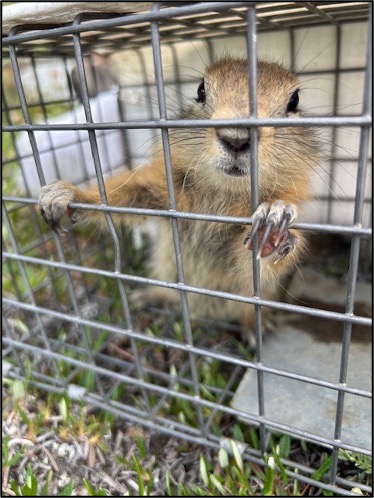
An arctic ground squirrel checking out the scientists from inside a trap
An arctic ground squirrel checking out the scientists from inside a trap. Photo by Rachel Rigenhagen.

The activities are as follows:

The Arctic is home to a unique biome, known as tundra. Found at Earth’s northernmost region, the tundra ecosystem is defined by frozen land. Permafrost is a thick underground layer of organic matter, soil, rock, and ice that has been frozen for at least two full years. Each summer as the temperature warms, a thin upper layer of frozen soil thaws, refreezing again the following winter.

Although the tundra might be far away from where most people live, it is connected to the entire globe through the atmosphere. This means it is affected by climate change, just like other places on Earth. In the tundra, increasing temperatures are causing snow to melt and the top layer of permafrost to thaw earlier each year.

Arctic ground squirrels, also called siksik (pronounced shrick-shrick) in the Inuktitut language, are an important mammal species that call the tundra home. They hibernate for roughly eight months – the longest of any mammal in the world. As they hibernate, the snow and frozen permafrost insulate their burrows and protect them from severe cold. As the summer months approach, the squirrels emerge and move above ground. Their mating season begins immediately after hibernation ends. With only four months out of their burrows, they have to maximize their time! 

Cory is a scientist who lives in Colorado but travels to the Arctic to do research at Toolik Field Station. For over 25 years, Cory and his research team have been studying the ground squirrel populations. While at Toolik recently, Cory was surprised to discover that male and female ground squirrels were emerging from hibernation on different schedules. He is worried these mismatches could be due to climate change. 
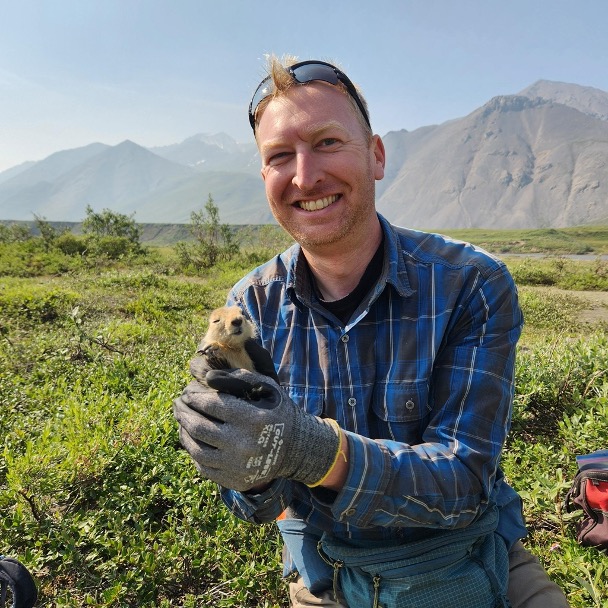
Austin holding an arctic ground squirrel that has been tagged in front of an Arctic scene background.
Austin, a PhD student in Cory’s lab, releases an arctic ground squirrel that has been tagged. Photo by Rachel Rigenhagen.

This made Cory wonder how ground squirrels know when to come out of their burrow. He suspected that ground squirrels use cues from their environment, such as increasing temperatures, permafrost thaw levels, or the length of time they have been in hibernation. Some of these environmental cues, such as the timing of permafrost thawing, are affected by increased temperatures. Other cues are not affected by temperature, such as the length of time squirrels have been hibernating. If males and females are using different cues, this could be why they are coming out at different times.

To investigate his idea, Cory and his research team turned to data they have been collecting over time. Each year, the research team temporarily captures squirrels. They record each squirrel’s sex, give them a unique ID, and put collars on them before releasing them. The collars can detect light, which is used to know when the squirrels are above ground. For each squirrel, the team records the first date that light was detected after hibernation, called the emergence date. Cory used Julian dates, which start with January 1 as Day 1 and continue to count up by one for each day. 

Cory also looked at the data on snowmelt as a potential environmental cue that the squirrels were using. Each year Cory’s team installs cameras on tall towers so that they can use images to measure daily snow cover. When no snow was detected, they measured this as the snowmelt date. Using these two sources of data, they can look for any patterns in emergence dates and spring snow melt. 

Featured scientist: Cory Williams (he/him) from Colorado State University and Toolik Field Station. Written by Claire Gunder (she/they) and Rachel Rigenhagen (she/her), Avalon School, St. Paul, Minnesota.
Flesch–Kincaid Reading Grade Level = 8.7

Streams as sensors: Arctic watersheds as indicators of change

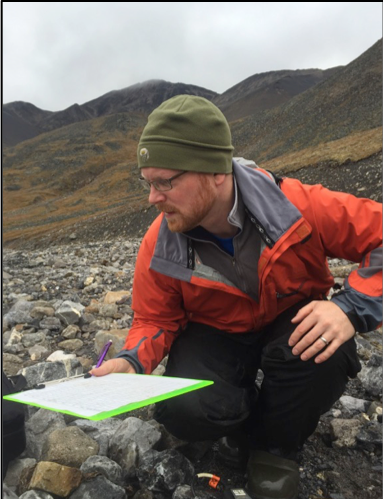
Jay taking field notes next to a rocky Tundra stream.

The activities are as follows:

The Arctic, Earth’s region above 66° 33’N latitude, is home to a unique biome, known as tundra. A defining trait of tundra ecosystems is the frozen land. Permafrost is the underground layer of organic matter, soil, rock, and ice that has been frozen for at least 2 full years. Plant material decays slowly in the Arctic because of the cold temperatures. Building up over thousands of years, the plants become frozen into the permafrost. Permafrost represents a very large “sink” of dead plant material, nutrients, and soil that is locked away in a deep freeze. 

Though the Alaskan Arctic may seem far away from where you live, tundra permafrost is important for the entire globe. During the past few thousand years, Earth’s climate has naturally changed a little over time, but because humans are adding greenhouse gases to the atmosphere, the average global temperature may increase by as much as 2 to 4oC over the next century. As a result of global climate change, permafrost has become less stable. By causing warmer and wetter conditions in the Arctic, thawing permafrost soils release ancient material that was previously frozen and locked away. Two important materials are dissolved nitrogen (N), which is a nutrient critical for plant growth, and carbon (C), which is stored in plant matter during photosynthesis. These released materials can be used again by plants, but some is carried away as melted water flows from the land into rivers and streams. You can imagine N and C in permafrost like a bank account where the landscape is the savings account. The land slowly deposits or withdraws N and C from the savings account, while the water receives any excess N and C that the land does not save.

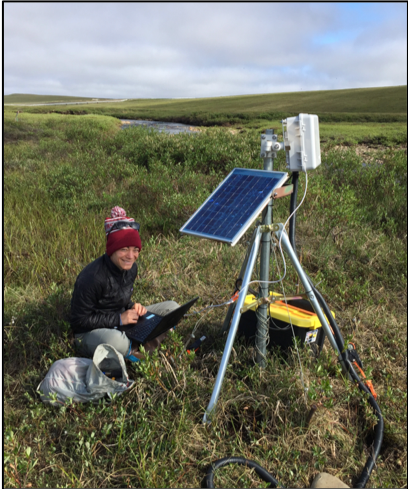
Arial downloads data from a water quality monitoring station at the Kuparuk River. The station is connected a sensor that stays in the river and takes a reading for both carbon and nitrogen concentrations every 15 minutes.

The water that melts as permafrost thaws flows into a stream, ultimately ending up in an ocean. Watersheds are the network of streams and rivers that flow to a single point as they empty out into the ocean. The water at the end of the watershed therefore reflects all the changes that happened across a large area. Scientists use Arctic watersheds as large “sensors” to understand how and when landscapes may be releasing material from thawing permafrost. 

Because the Alaskan Arctic is a vast, sparsely populated area, scientists often rely on established field stations to conduct experiments, collect observational data, and develop new understanding of Arctic ecosystems. One of these field sites is Toolik Field Station. Scientists working at Toolik have been monitoring terrestrial and aquatic Arctic ecosystems since the late 1970s. 

Arial and Jay are aquatic scientists who work at Toolik. They are interested in how Arctic watersheds respond to climate change. Together, Arial and Jay act like ecosystem accountants: they use the chemistry within the water to monitor changes in ecosystem budgets of C and N. Arial and Jay used both historic data and water quality sensors deployed in 2017 and 2018 to monitor the N and C budget in the Kuparuk River. They use this data to calculate how much N and C the river is spending. They measure this as the total export in units of mass per year. This mass per year is determined by multiplying concentration (mass/volume) by flow (volume/day) and adding these values across the whole season (mass/year). These budgets at the watershed outlet help reveal signals of how this tundra landscape may be changing. In this way, they can assess if the landscape savings account for N and C is being depleted due to climate change. 

Featured scientists: Arial Shogren and Jay Zarnetske from Michigan State University

Flesch–Kincaid Reading Grade Level = 10.8