


The activities are as follows:
- Teacher Guide
- Student Activities, Graph Types A-C, Level 3
- Grading Rubric, CER Tool, and Other Resources
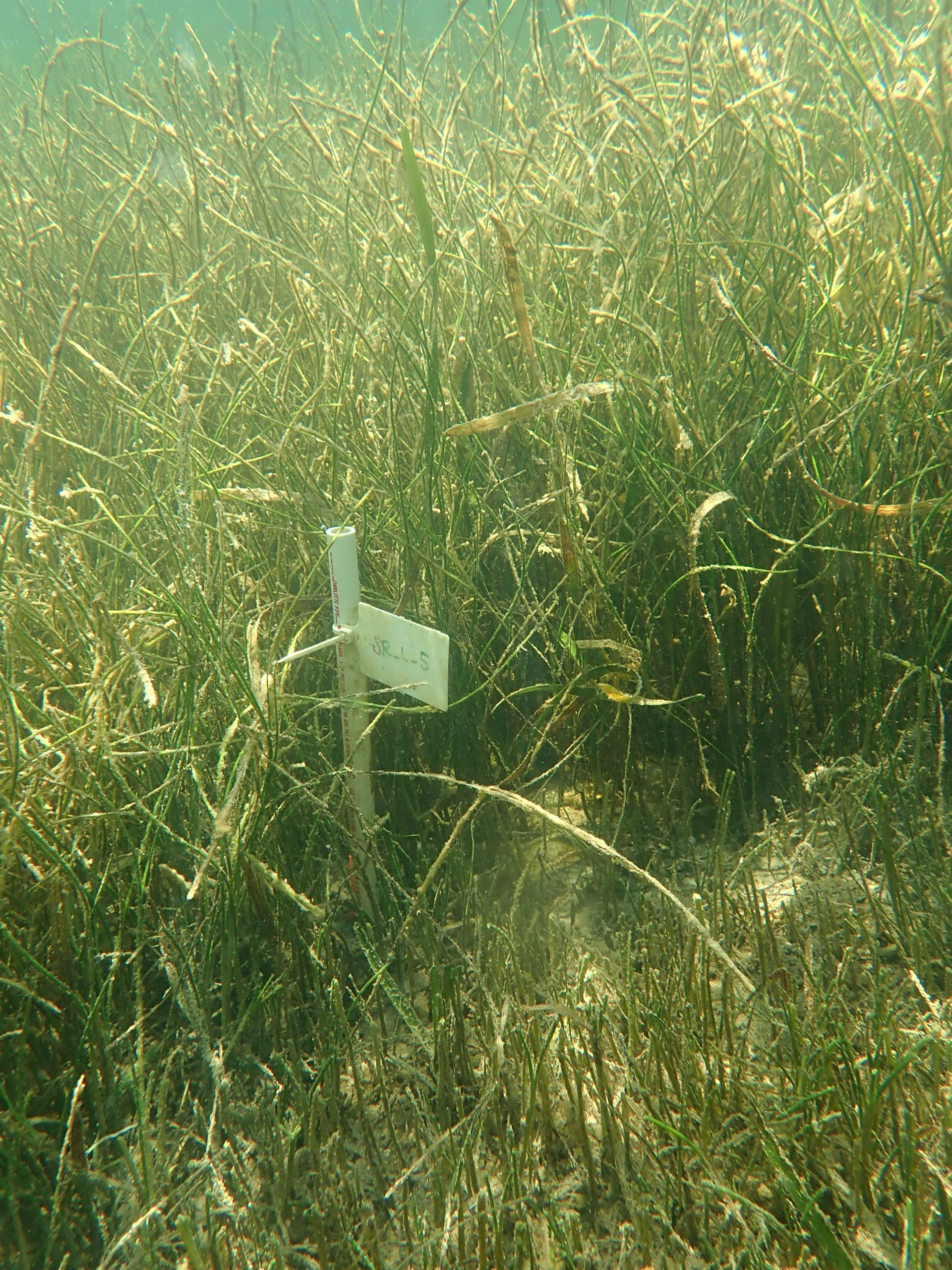
The ocean, like land, has a food web made up of organisms that depend on one another for energy. At the base of many coastal marine food webs are seagrasses, plants that grow in shallow waters along coastlines. Seagrasses use photosynthesis to convert carbon dioxide, water, and sunlight into sugars for energy. During this process, they also store carbon in their leaves, roots, and stems.
Seagrass influences the fate of carbon along the coastline in several ways. If animals eat the seagrass leaves, called grazing, the carbon becomes part of their bodies and moves through the food web. If the seagrass is not eaten, it dies and decomposes. Much of this carbon can become buried in the sediment, where it may remain stored for many years. In addition, growing seagrass leaves can capture detritus, or dead plant and animal material. This traps and stores additional carbon in the system.
percent organic carbon.
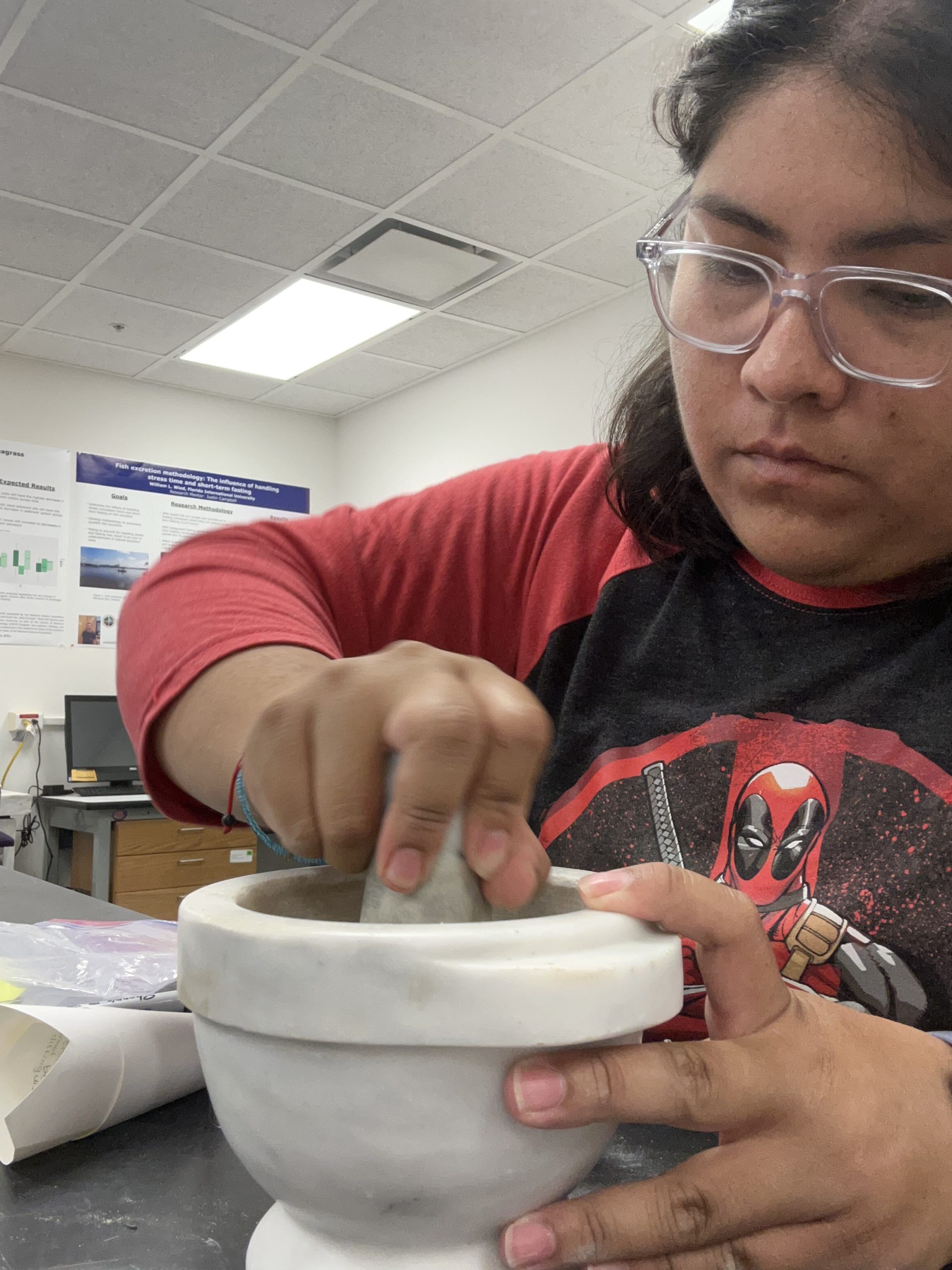
Katheen is a teacher interested in understanding how seagrass contributes to carbon storage. She understands the importance of seagrass because when carbon is stored in the sediment, it helps reduce the amount of carbon dioxide in the atmosphere. Katheen grew up in Miami, Florida, where she spent many summers at the beach as a kid. Later, while participating in a research program for teachers, Katheen had the opportunity to work alongside scientists studying carbon storage in seagrass ecosystems.
Katheen worked alongside two graduate students, Jezebel and Kendric, in Key Biscayne, Florida. They wanted to test two ideas about the effects of grazing on carbon storage in sediments. First, they predicted that grazing would reduce the amount of carbon stored in sediments because grazers would remove seagrass tissues before it decomposed. Second, they predicted that the larger the area grazed the less carbon there would be, because large areas without seagrass leaves would be less able to stop and trap the detritus floating by that adds additional carbon to the system.
To test their two hypotheses, they set up experimental plots. First, they set up control plots where the seagrass was left undisturbed. Next, they set up experimental plots of three different sizes – small (0.25 m2), medium (1.0 m2), and large (4.0 m2). In these experimental plots, the team hand-clipped the seagrass leaves by hand, once a month for a year. There were five replicates of the control and each size of grazed plots. At the end of the study, Katheen and her team collected sediment cores from each plot. In the laboratory, they measured the percent organic carbon. Percent organic carbon is the percentage of a soil or sediment sample made up of carbon from organic matter, such as the remains of plants, animals, and other living organisms.
Featured scientists: Katheen Bravo (she/her), Kendric Nixon (he/him), Jezebel Powers (she/her), and Justin Campbell from Florida International University. Written by: Kathleen Ortiz (she/her).
Flesch–Kincaid Reading Grade Level = 9.9
This material is based upon work supported by the National Science Foundation Awards #DBI-2240593, DBI-2333228, #DEB-2424122, and #DEB-2025954.