


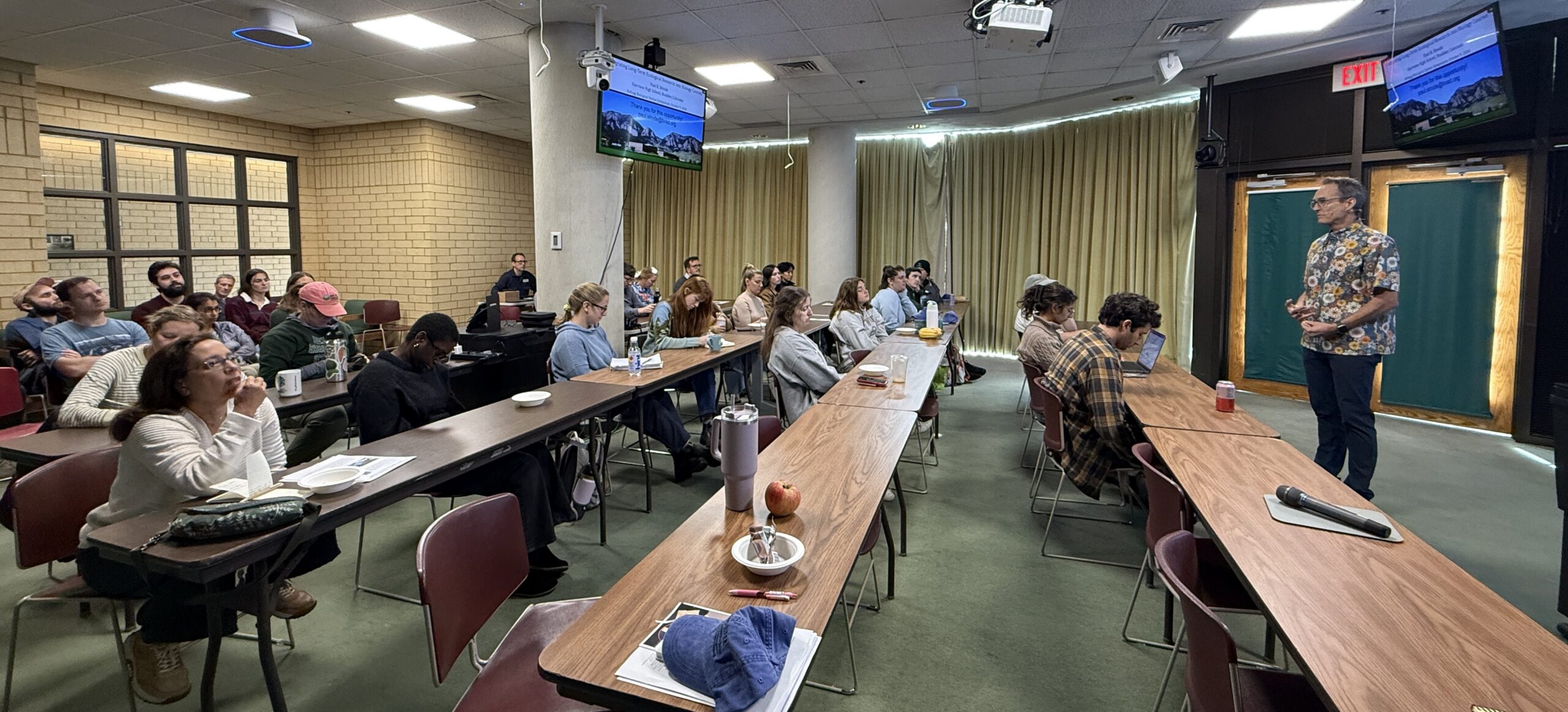
On November 9th, high school biology teacher, Dr. Paul Strode, made his second visit to the Kellogg Biological Station (KBS) to deliver a seminar. Paul shared his own scientific journey, and how he translates that experience to his own students. Details on the seminar are below.
Paul wrote two papers that informed Data Nuggets development. The first paper focuses on how we use hypotheses in science, and how being intentional about the distinction between hypotheses and predictions is essential in our own science writing (this made us totally revamp how we did them in Data Nuggets!). The second paper is his newest on how he began long-term data collection with his students.
View his slides with embedded links.
2026 stats guide for students.
Getting Students to Think, Talk, and Write Like Scientists
Methods for teaching and learning science must be designed so that students hone the skills and practices of thinking, talking, and writing like scientists. However, if educators themselves are not trained in and comfortable with the science practices, it may be impossible to effectively impart these skills to students. The first half of this discussion will focus on my own rollercoaster story of becoming a capable scientist and science educator. The second half will focus on developing students’ ability to engage in science as scientists do – by asking questions, thinking critically, reasoning quantitatively, conducting authentic investigations, and communicating scientific ideas. We will explore a few approaches and strategies I use for building an effective learning environment that supports engaging, meaningful, and lasting science learning. These approaches include helping students understand the math behind data and error analysis, how to use and interpret basic inferential statistics, how to engage with and extract key information in technical papers, and how to present complex ideas in easy-to-understand ways. Two storylines will arch through the talk: serendipity and the critical importance of long-term ecological research to understanding and conserving nature.